 listicle
5 Best Fabric Materials for Exhibition Backdrops
Table of Contents
- What Makes the Right Fabric Material for Exhibition Backdrops
- Quick Comparison Table
- 100% Polyester: The Industry Standard
- Wrinkle-Resistant Backdrop Fabric Options
- Canvas and Heavy-Duty Fabrics
- Pipe and Drape Material Comparison for Cost and Logistics
- Flame Retardant Event Drapery Standards and Safety
- How to Choose the Right Fabric for Your Event
- Frequently Asked Questions
Last Updated: September 30, 2026
What Makes the Right Fabric Material for Exhibition Backdrops
Choosing the wrong fabric for your exhibition backdrop costs time, money, and credibility. A wrinkled, faded, or poorly constructed backdrop undermines your entire event presence, no matter how compelling your message is. The right fabric material transforms your booth from forgettable to memorable.
The decision isn't just about aesthetics. It's about durability, portability, print quality, fire safety, and how the fabric performs under real event conditions. According to industry standards for trade show displays, fabric choice directly impacts both setup time and visual impact on the show floor.
Below, we'll walk you through the 5 best fabric materials for exhibition backdrops, what each does well, where it falls short, and when to use it.
Quick Comparison Table
| Fabric Material | Best For | Key Advantage | Main Limitation |
|---|---|---|---|
| 100% Polyester | General exhibitions, high-volume events | Wrinkle-resistant, cost-effective | Can appear slightly translucent without backing |
| Stretch Fabric (Tension Systems) | Minimalist trade show designs | Wrinkle-free, sleek appearance | Requires specific aluminum frame hardware |
| SEG Silicone Edge Graphics | Premium trade show booths | High-definition printing, seamless finish | Requires compatible frame systems |
| Canvas | High-end exhibitions, permanent installations | Heavy-duty, professional finish | Heavy and difficult to transport |
| Lightweight Knit | Frequent travelers, budget-conscious exhibitors | Minimizes shipping costs | Less durable than heavier fabrics |
100% Polyester: The Industry Standard
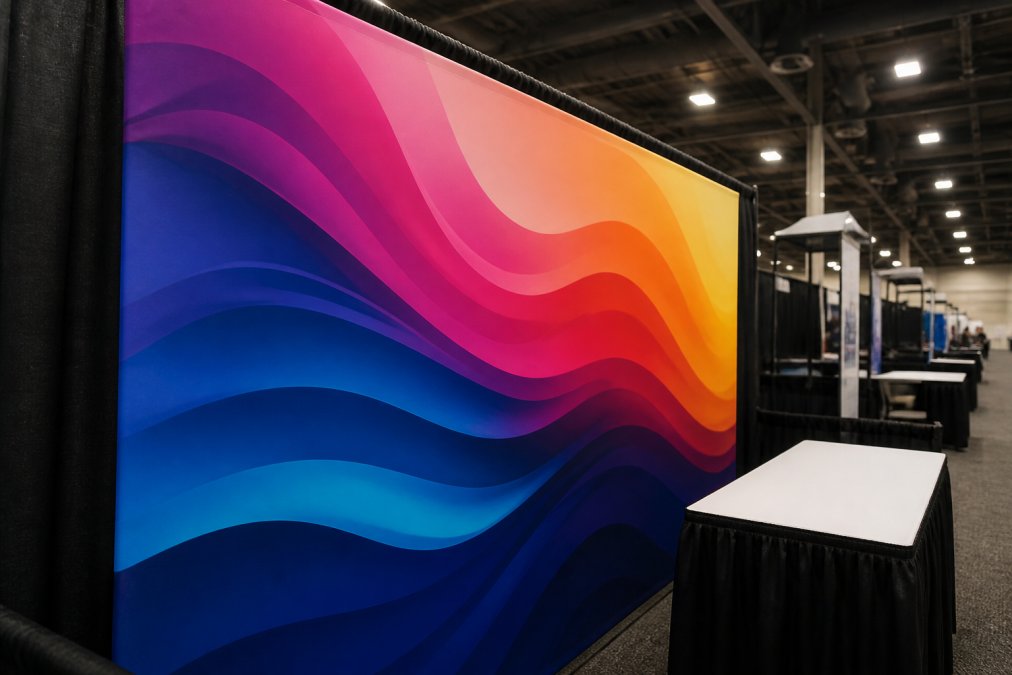
Polyester dominates exhibition backdrops for good reason. It's lightweight, portable, and resists wrinkles far better than natural fibers. When dye-sublimation printing is applied to polyester, colors remain vibrant and saturated even after repeated use and cleaning.
Lighting Performance and Print Quality
Polyester's matte finish absorbs LED light rather than bouncing it back, eliminating hot spots and glare. This prevents washed-out photographs and uneven brightness in video content by diffusing light evenly across the fabric surface.
Dye-sublimation printing penetrates polyester fibers, preserving color accuracy under LED lighting and preventing fading from UV and blue wavelengths.
Confirm the finish specification when ordering, matte is standard for indoor trade shows; semi-gloss introduces glare.
Durability and Maintenance
Machine washability eliminates professional cleaning costs between events. Polyester's excellent color fastness prevents fading. Wash on gentle cycle with cool water and air-dry to preserve print quality.
Thin polyester can appear translucent without backing. Solid-color or light designs may need heavier-weight polyester (8-10 oz per square yard) or lining.
For most events, 100% polyester is the right balance of durability, cost, and performance.
Wrinkle-Resistant Backdrop Fabric Options
Wrinkles undermine professional appearance. Two solutions address this: stretch fabrics and SEG silicone edge graphics.
Stretch Fabric (Tension Backdrop Systems)
Stretch fabrics pull tight over aluminum frames, eliminating wrinkles and creating a sleek, modern look. Setup takes 15-20 minutes for a standard 10x10 booth. Best for minimalist designs with bold branding and seamless construction.
The tradeoff is hardware dependency, you need compatible aluminum frame systems, adding cost for one-off events but making sense for regular use.
SEG Silicone Edge Graphics
SEG (Silicone Edge Graphics) combines dye-sublimation printing with tension-fit hardware for edge-to-edge graphics with no white borders. Popular at premium trade shows where visual impact influences booth traffic, the professional finish justifies higher cost.
Like stretch fabric, SEG requires specific frame hardware. Swapping graphics requires removing and re-installing silicone edges, making it inefficient for frequent design changes.
Canvas and Heavy-Duty Fabrics
Canvas delivers premium aesthetics with natural texture and matte finish that absorbs light, eliminating glare. Heavy-duty construction resists tearing and maintains appearance across dozens of events, making it ideal for permanent installations.
The major drawback is weight. Canvas backdrops are significantly heavier than polyester, which increases shipping costs and setup time. A 10x10 canvas backdrop can weigh 40-60 pounds, compared to 10-15 pounds for equivalent polyester. For exhibitors shipping backdrops across the country, this cost adds up quickly.
Canvas also wrinkles more readily than polyester. While steaming or careful packing minimizes this, expect some wrinkling during transport. Professional pressing before events is often necessary.
Use canvas for high-end exhibitions, permanent studio installations, or events where aesthetic premium justifies the logistics burden.
Pipe and Drape Material Comparison for Cost and Logistics
When evaluating fabric for pipe and drape systems, cost-per-use analysis matters. But true cost-per-use includes not just material and shipping, but storage, maintenance, and care between events. Lightweight knit fabrics minimize shipping expenses, while heavier materials offer superior durability. The right choice depends on your rental frequency, event schedule, and storage capacity.
Shipping and Weight Considerations
Lightweight knit fabrics (4-6 oz per square yard) reduce freight costs by 40-60% compared to standard polyester. For exhibitors attending multiple shows annually, this savings is significant. The tradeoff is durability; these fabrics won't withstand as many rental cycles as heavier options.
Standard polyester (8-10 oz) balances cost and longevity. It's heavy enough to last through dozens of events but light enough to keep shipping reasonable.
Heavy fabrics like canvas and 12+ oz polyester offer maximum durability but require careful cost-per-use calculation. If you're using a backdrop only once or twice, the durability advantage doesn't justify the shipping expense. If you're renting it 20+ times annually, the lower per-use cost becomes compelling.
Storage, Folding, and Long-Term Care
A hidden cost in backdrop ownership is storage and maintenance. Improper storage creates permanent creases, color fading, and mildew, problems that reduce the lifespan of even high-quality fabrics.
Polyester and lightweight knit: These fabrics fold compactly and store in standard cardboard boxes or rolling cases. Store in a climate-controlled space (ideally 60-75°F, 30-50% humidity) to prevent mildew and color fading. Polyester can be stored for months without significant wrinkle damage if folded carefully.
True Cost-Per-Use Calculation
To calculate true cost-per-use, include:
- Material and printing cost
- Shipping (both directions)
- Storage space (rent or square footage if in-house)
- Maintenance (cleaning, steaming, professional pressing)
- Replacement frequency (how many years before the fabric degrades)
For example, a standard 10x10 polyester backdrop might cost $400 to purchase, $100 to ship to each event, and require $20 in steaming between uses. Over 10 events, that's $1,200 total cost, or $120 per use. A canvas backdrop might cost $800 to purchase, $200 to ship per event, and require $100 in professional pressing per event. Over 10 events, that's $3,000 total cost, or $300 per use, despite canvas's superior durability.
Flame Retardant Event Drapery Standards and Safety
The cost difference between flame-retardant and non-flame-retardant fabrics is minimal, typically 5-10% premium. The safety benefit and venue requirement make it a non-negotiable investment.
How to Choose the Right Fabric for Your Event
Start with three questions: What's your budget? How often will you use this backdrop? What aesthetic matters most?
Frequently Asked Questions
What is the best fabric for a wrinkle-free exhibition backdrop?
Stretch fabric and SEG silicone edge graphics are the top choices for wrinkle-free displays. Stretch fabric pulls tight over aluminum frames to eliminate creases, while SEG fabric uses silicone strips sewn into edges for a taut, frame-fitted appearance. Both deliver a professional, polished look without the need for steaming. For a more budget-conscious option, 100% polyester is highly resistant to creasing during transport and setup, making it ideal for exhibitors who need reliable wrinkle resistance without premium pricing.
Which fabric material is best for backlighting a trade show display?
SEG silicone edge graphics and stretch fabric are specifically designed for backlit LED frames. Their tight, wrinkle-free tension fit allows light to distribute evenly across the graphic without shadows or puckering. Polyester can work with backlighting but may show slight translucency if not weighted properly. Avoid canvas and muslin for backlit applications, as their heavier construction and light-absorbing properties reduce the effectiveness of backlighting and create uneven illumination.
Are flame-retardant fabrics required for exhibition backdrops?
Most convention centers and venues require flame-retardant fabrics for exhibition backdrops and pipe and drape systems. Check your venue's specific fire code compliance requirements before ordering. Many professional-grade polyester, canvas, and stretch fabrics meet NFPA 701 or similar flame-retardant standards. Confirm with your rental provider or venue that your chosen fabric meets local fire safety regulations. Non-compliant materials can result in last-minute rejections or event cancellations.
How do I choose the right fabric weight for a pipe and drape system?
Fabric weight, measured in gsm (grams per square meter), determines durability, portability, and appearance. Heavier fabrics (300+ gsm) like canvas offer superior durability and professional finish but are harder to transport. Mid-weight polyester (150-250 gsm) balances durability with portability. Lightweight knit fabrics (under 150 gsm) minimize shipping costs and are ideal for frequent travelers. Consider your event frequency, storage space, and budget. For one-time events, lightweight options work well; for repeated use, mid-weight polyester offers the best value.
What's the difference between polyester and canvas for event backdrops?
Polyester is lightweight, wrinkle-resistant, machine washable, and cost-effective for repeated rentals. It offers excellent color saturation and a non-reflective surface ideal for photography. Canvas is heavier, more durable, and provides a premium, high-end appearance with superior light absorption. Canvas is better for permanent installations or high-end exhibitions but requires more careful handling and storage. Polyester wins for portability and maintenance; canvas wins for longevity and prestige. Choose based on your event type, frequency, and budget.