 ultimate-guide
Benefits of Professional Event Drape Installation
Table of Contents
- What Professional Event Drape Installation Actually Delivers
- Venue Transformation: Concealment, Aesthetics, and Atmosphere
- Fire Safety Standards and Structural Engineering Compliance
- DIY vs Professional Event Draping: An Honest Comparison
- How to Choose Event Drapery Height for Your Venue
- Pipe and Drape Rental Cost: Budgeting and ROI
- Post-Event Teardown, Fabric Lifecycle, and Sustainability
- Frequently Asked Questions
Last Updated: August 17, 2026
What Professional Event Drape Installation Actually Delivers
Professional event drape installation is the process of designing, rigging, and securing fabric panels across a venue using engineered pipe-and-drape systems, custom rigging points, or tension frameworks, executed by trained installers who understand both the aesthetic and structural demands of the work.
Most event planners underestimate what they're actually buying when they hire professionals. They think they're paying for labor. What they're actually buying is risk management, visual precision, and the kind of fabric movement and spatial definition that photographs beautifully and holds up through a six-hour gala.
At Event Drape Rental, we've seen the full spectrum: flawlessly draped ballrooms that become the centerpiece of a brand launch, and last-minute DIY attempts that unraveled, literally, ninety minutes before doors opened. The difference isn't always budget. It's expertise applied at the right moment.
Here's what professional installation actually delivers across five concrete dimensions:
- Structural integrity, load-bearing capacity is calculated, not guessed
- Sightline management, panels are positioned to direct attention, not just cover walls
- Tensioning and pleating precision, fabric weight and drape panels are matched to the rigging system
- Safety compliance, fire retardant fabric certification is verified and documented
- Installation efficiency, setup and teardown happen on schedule, without venue damage
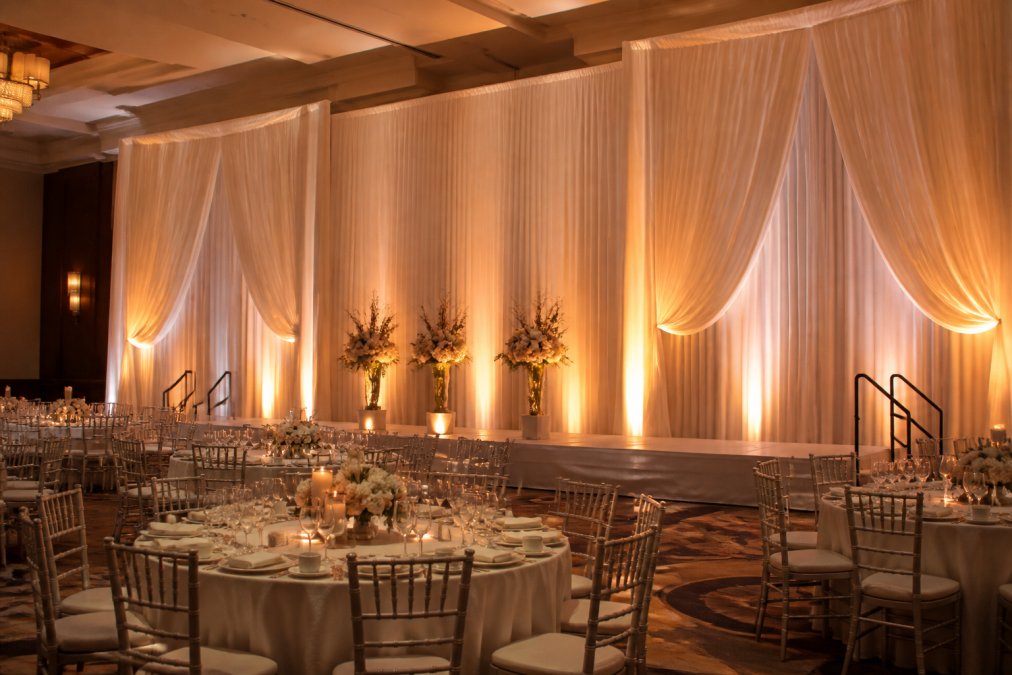
The result is an event atmosphere that reads as intentional and polished, which is exactly what a corporate client or wedding couple is paying for.
Venue Transformation: Concealment, Aesthetics, and Atmosphere
Draping a venue well is a design discipline. The best installations don't just look good in isolation, they recalibrate how guests perceive the entire space.
Hiding Unsightly Venue Features
Most venues weren't built for aesthetics. Convention centers have exposed HVAC ductwork, loading dock doors, and concrete block walls. Hotel ballrooms often have dated wallpaper, mismatched paneling, or low ceilings that fight against a luxury event decor concept.
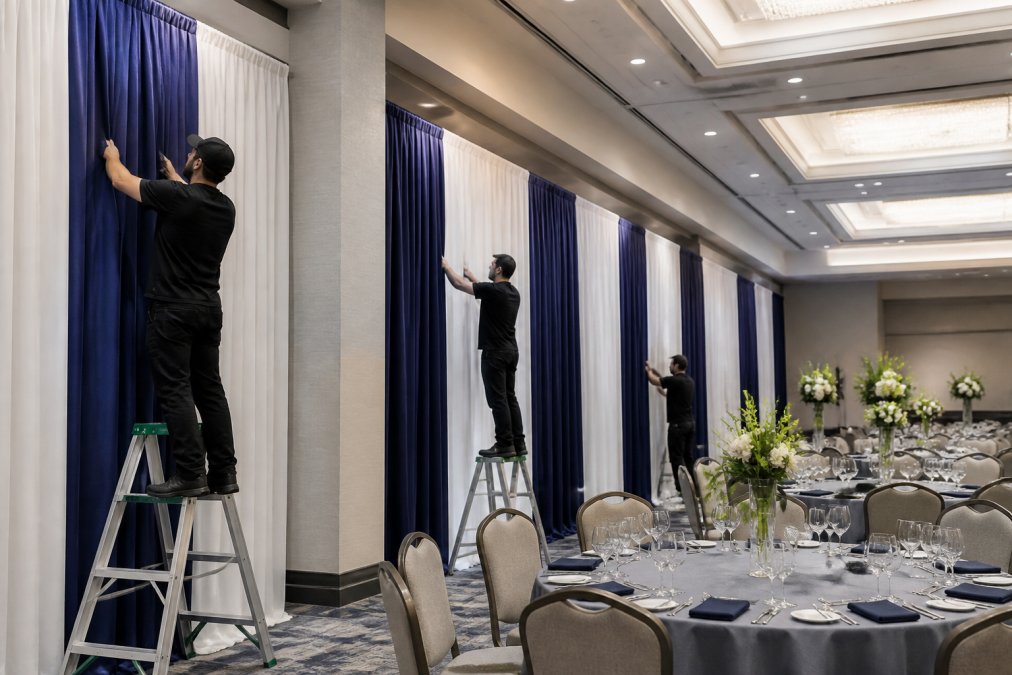
Venue concealment is one of the most practical applications of professional event drape installation. A skilled installer reads the room differently than a decorator: they identify structural columns that need to be wrapped, back-of-house access points that need to be screened, and ceiling grids that need to disappear behind fabric. They choose fabric weight and drape panels that hang cleanly against irregular surfaces without gapping or pulling.
This isn't cosmetic. Venue damage prevention is a real concern, improperly tensioned systems can leave marks on walls, stress ceiling anchors, or, in worst cases, pull down fixtures. Professionals know how to rig without causing damage, which matters when the venue's security deposit is on the line.
Acoustic Dampening and Lighting Backdrops
Fabric does more than look good. Heavy drape panels absorb sound, reducing echo in hard-surfaced spaces like warehouses and convention halls. This acoustic dampening effect is particularly valuable for corporate events where speech intelligibility matters, presentations, award ceremonies, and keynote addresses all benefit from a room that doesn't ring.
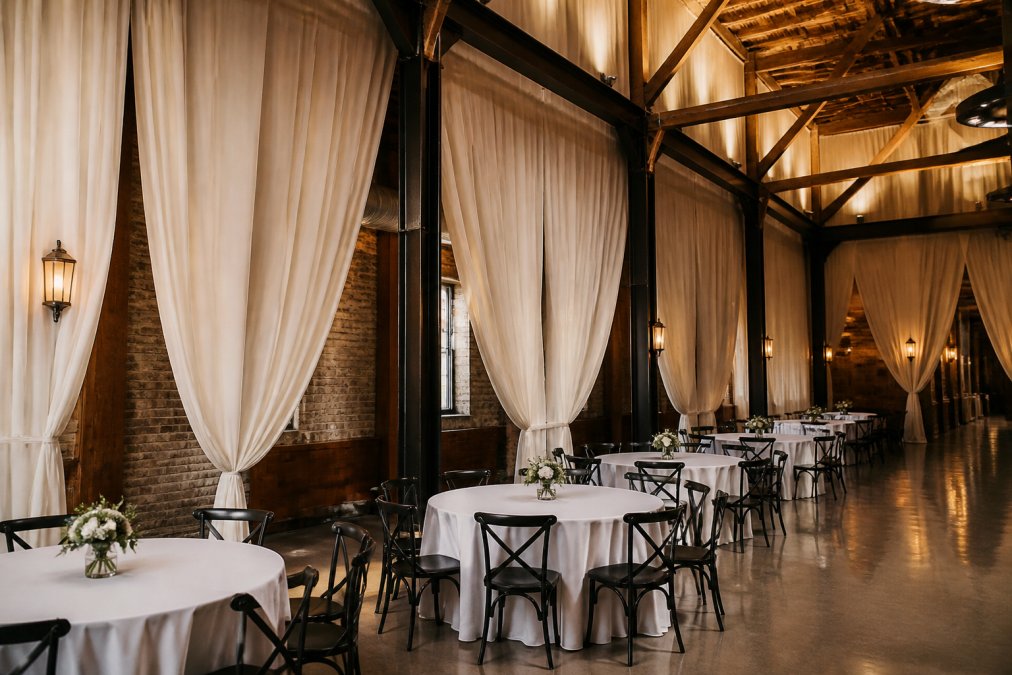
The same panels that reduce echo also function as backdrop design surfaces for lighting. A white or ivory drape panel becomes a projection screen. A deep navy or charcoal panel saturates with color wash in ways that painted walls never do. Professional installers position panels to maximize both functions, coordinating with lighting vendors on rigging placement so the two systems don't conflict.
According to the Acoustical Society of America's guidance on room acoustics, fabric treatments are among the most effective and reversible acoustic interventions available for temporary event spaces.
Fire Safety Standards and Structural Engineering Compliance
This is the section most guides skip. It's also the most important one.
Fire retardant fabric is not optional for public events, it's a code requirement. The NFPA 701 standard for flame resistance of textiles governs which fabrics can legally be used in public assembly spaces in the United States. Compliance requires that fabric either be inherently flame-resistant (woven from fire-resistant fibers) or treated with a flame retardant that meets test method requirements. Certificates must be available on site for inspection.
Professional installers know this. They work with suppliers who provide NFPA 701-compliant materials and maintain documentation. A DIY renter who sources fabric independently may not know whether their material passes the vertical flame test, and a venue fire marshal who shows up for a pre-event inspection will.
Structural engineering is the other half of the compliance picture. Pipe and drape systems that reach 20, 25, or 30 feet carry significant load. Uprights must be rated for the span and fabric weight they're supporting. Base plates must be weighted appropriately for the height. Professional rigging for ceiling-mounted systems requires understanding the load-bearing capacity of the anchor points, something that varies dramatically between a purpose-built convention center and a converted warehouse.
The liability exposure from an improperly rigged system is real. Professional installation teams carry insurance coverage that protects the client and the venue. That coverage doesn't exist when a team of volunteers assembles a 20-foot system from a rental kit.
DIY vs Professional Event Draping: An Honest Comparison
The honest answer is that DIY pipe and drape works, for simple setups, experienced teams, and forgiving venues. It does not work well for tall installations, complex layouts, or high-stakes events where the margin for error is zero.
| Factor | DIY Installation | Professional Installation |
|---|---|---|
| Setup time | Unpredictable; often longer than planned | Scheduled and reliable |
| Fabric appearance | Variable; wrinkles and sags common | Tensioned, pressed, consistent |
| Safety compliance | Renter's responsibility | Verified by installer |
| Height capability | Practical limit around 12-16 ft | Up to 30 ft with proper rigging |
| Venue damage risk | Higher without experience | Managed and insured |
| Teardown logistics | Requires your team's time | Handled by install crew |
| Best for | Simple backdrops, small events | Galas, trade shows, weddings |
The most common DIY failure isn't structural, it's visual. Fabric that isn't properly tensioned develops horizontal stress lines. Panels that aren't matched for fabric weight hang at different lengths. Pleating styles that look clean in a product photo look chaotic when assembled by someone doing it for the first time in a dim venue at 7 a.m.
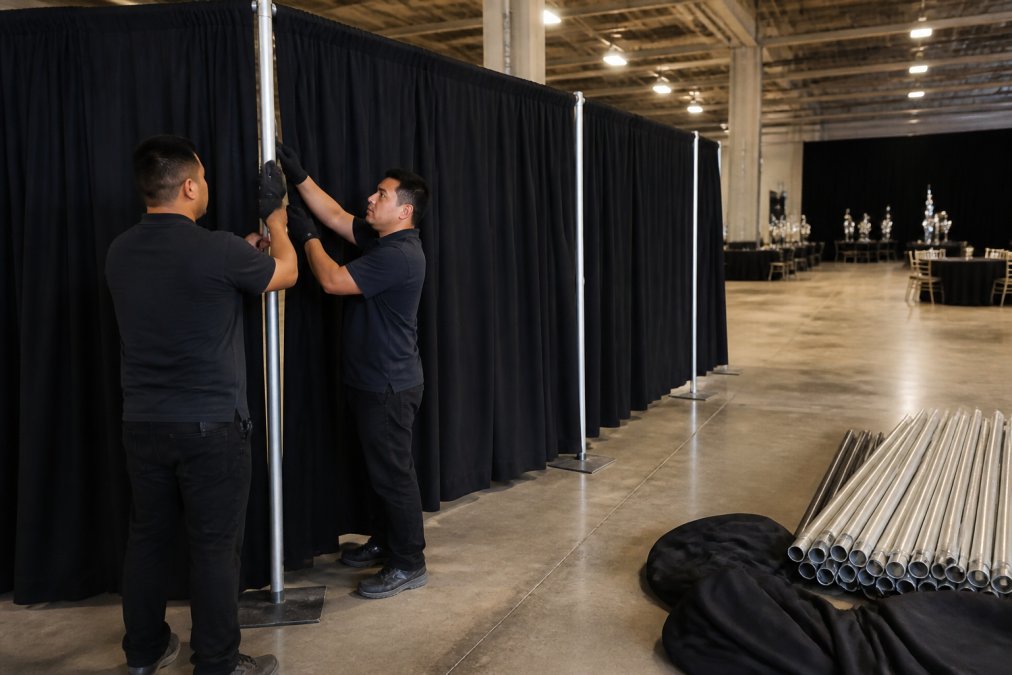
Professional installation also changes the event logistics equation. When you hire an install crew, your team isn't spending setup day wrestling with upright bases and crossbars. They're doing the work only they can do: coordinating vendors, managing the client, and making sure everything else runs on schedule.
How to Choose Event Drapery Height for Your Venue
Choosing the right drapery height comes down to three variables: ceiling height, intended visual effect, and the structural system being used.
The general rule is that drape panels should reach at least 80-85% of the ceiling height to read as intentional rather than undersized. A 20-foot ceiling with 12-foot drapes looks incomplete. The same 12-foot drapes in a 14-foot room look clean and proportionate.
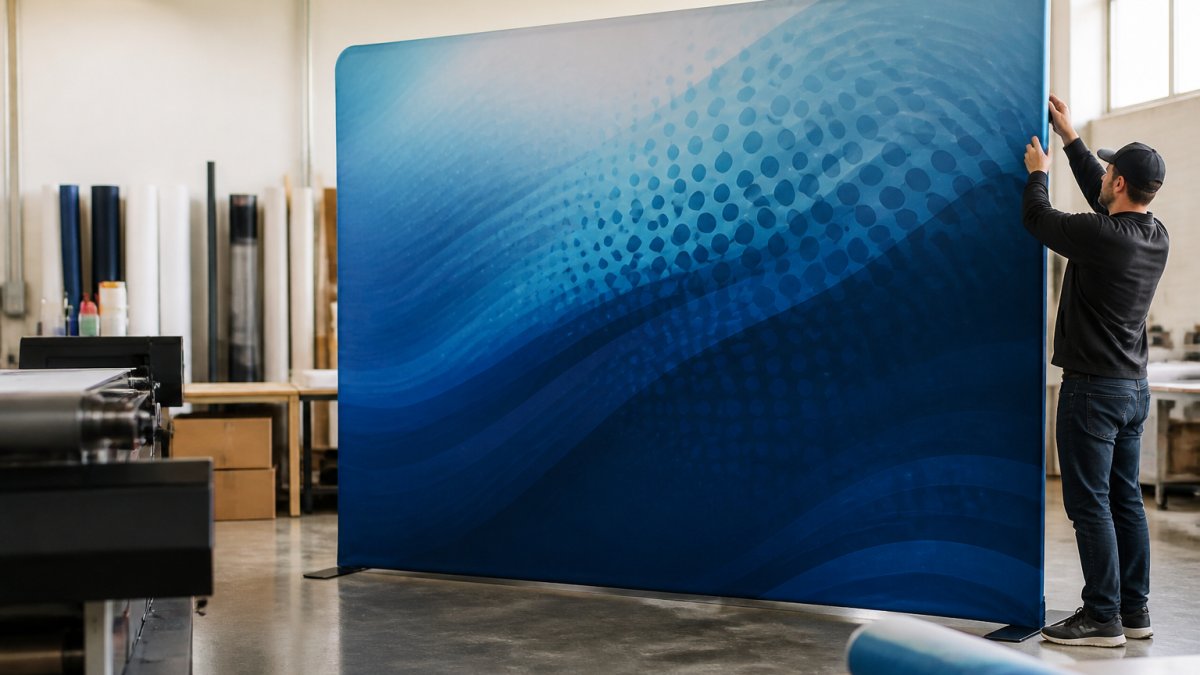
For event branding applications, trade show booths, stage backdrops, branded photo walls, height is often determined by the graphic or logo placement. The panel needs to be tall enough that branding elements sit at eye level and above, not at knee height.
Event Drape Rental's inventory runs from 12 to 30 feet in height, which covers the full range from standard hotel ballrooms to high-bay convention halls and converted industrial venues. For a converted warehouse with 40-foot ceilings, the practical approach is often to create a defined zone within the space rather than trying to fill the full height, a 20-foot drape treatment that creates a ceiling-to-mid-wall effect can be more visually effective than an undersized panel that disappears in the upper void.
Here's a practical reference:
| Ceiling Height | Recommended Drape Height | Notes |
|---|---|---|
| 10-12 ft | 10-12 ft | Full-height treatment; minimal gap |
| 14-16 ft | 12-14 ft | Allow 1-2 ft gap at top |
| 18-20 ft | 16-18 ft | Uplight above drape for visual fill |
| 22-28 ft | 18-22 ft | Consider layered treatments |
| 30+ ft | 20-30 ft | Zone-based design recommended |
When in doubt, go taller. Fabric that falls short of its intended visual target is one of the most common, and most visible, mistakes in event draping.
Pipe and Drape Rental Cost: Budgeting and ROI
Pricing for event drape installation depends on quantity, panel height, fabric material, delivery logistics, and whether professional installation is included. Requesting a quote is the only way to get accurate numbers for a specific event, any figure published without those variables is guesswork.
What's worth understanding is the ROI framework. For a corporate gala or high-profile product launch, the venue transformation delivered by professional draping directly affects how the event is perceived, by clients, by attendees, and in post-event photography that gets shared and archived. A venue that photographs beautifully extends the event's value well beyond the night itself.
For trade show exhibitors, spatial definition is a direct competitive advantage. Pipe and drape systems that clearly define a booth's footprint, elevate branded backdrops, and create a professional enclosure signal seriousness to prospects walking the floor. The cost of that installation is a line item in the marketing budget, not the event budget, and it should be evaluated against the cost of appearing unprepared.
According to the Event Industry Council's guidance on event ROI measurement, venue presentation and environmental design consistently rank among the top factors influencing attendee perception of event quality.
For budget planning, the most useful approach is to get quotes for both DIY rental and professional installation, then factor in the hidden costs of DIY: staff time, setup duration, and the risk premium of a less-than-perfect result. Many planners who run that comparison find the gap is smaller than expected.
Post-Event Teardown, Fabric Lifecycle, and Sustainability
Teardown is where DIY installations often create their biggest problems. Fabric that went up in three hours can take five to come down safely, especially at height. Panels need to be de-tensioned in the right sequence to avoid tipping uprights. Fabric needs to be folded and packed correctly to avoid permanent creasing that damages the material for future use.
Professional teardown crews handle this as part of the installation contract. They arrive at the agreed post-event time, disassemble the system without damaging the venue, and pack everything for return or next-use storage. That matters for venue relationships, a venue that finds damaged walls or ceiling anchors after an event is a venue that won't work with that planner again.
The sustainability dimension of event draping is underappreciated. Rental fabric has a significantly lower environmental footprint than single-use decorative materials. A drape panel that gets used across fifty events over several years represents a fraction of the material consumption of disposable decor. As the U.S. Green Building Council's guidance on sustainable event practices notes, reusable materials and rental inventories are among the most effective strategies for reducing event waste.
Fabric lifecycle management, proper cleaning, storage, and inspection between uses, is what makes that sustainability case real rather than theoretical. Reputable rental providers maintain their inventory so that panels arrive clean, pressed, and free of damage. That's the quality assurance question worth asking any provider before you book: what does your inspection and maintenance process look like between events?
Custom installation and seamless integration across multiple events also depends on fabric that's in good condition. A drape panel with stress damage or permanent creasing won't tension properly, which undermines the entire visual effect regardless of how good the rigging is.
Managing the full scope of event drape installation, from fire safety compliance and structural engineering to teardown logistics and fabric condition, requires a partner with the inventory depth and operational discipline to execute reliably. Event Drape Rental offers drapes from 12 to 30 feet in height across an extensive range of colors and fabric materials, with both DIY rental and professional installation options to match your team's capacity and your event's stakes. Request a quote to get accurate pricing for your specific venue, timeline, and setup requirements.
Frequently Asked Questions
How much does professional event draping cost?
Professional event drape installation pricing depends on several factors: the size of the venue, the number of drape panels needed, fabric type, ceiling height, and whether teardown is included. There is no single industry-standard rate. The best way to get an accurate figure is to request a quote with your event dimensions, desired fabric, and timeline. Bundling installation with rental often produces better overall value than sourcing them separately.
What is the difference between pipe and drape and custom draping?
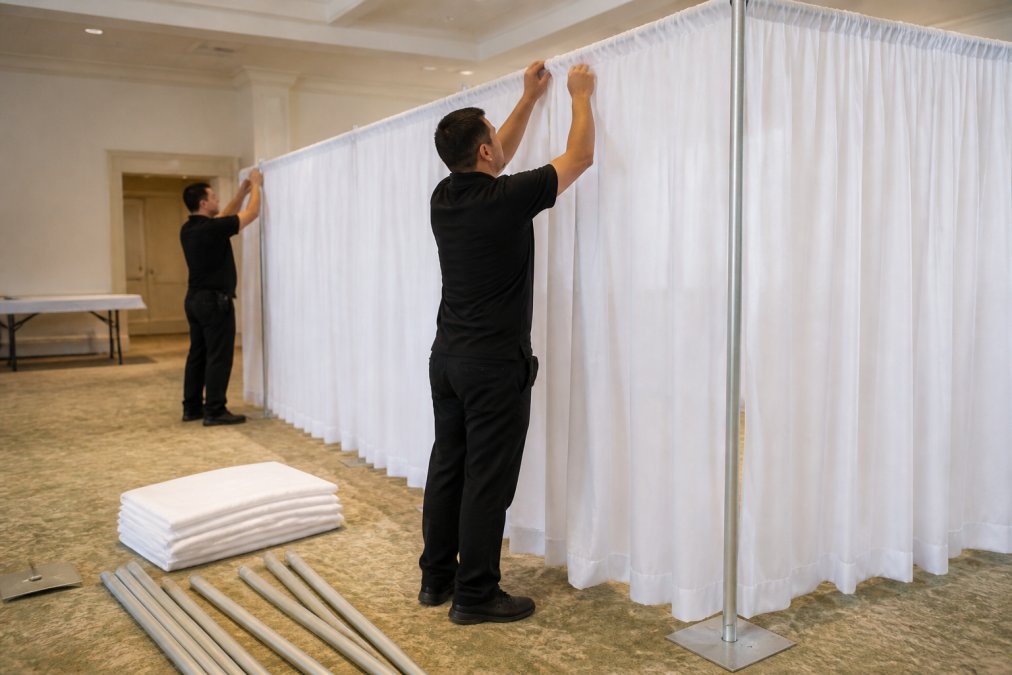
Pipe and drape uses a modular system of upright poles, horizontal crossbars, and fabric panels that can be configured quickly to divide spaces or create backdrops. Custom draping goes further, using fabric tensioned, pleated, or ceiling-mounted to achieve tailored looks like tent-style ceilings or fully wrapped walls. Pipe and drape suits trade show booths and quick room dividers; custom draping is standard for weddings, galas, and high-profile corporate events where visual softness and seamless integration matter most.
How does professional installation improve event safety?
Professional installers verify that all hardware meets load-bearing capacity requirements, secure uprights so fabric movement does not destabilize structures, and confirm that every fabric used carries a current NFPA 701 fire-retardant certification. Many venues and event insurance policies require documented compliance before an event can proceed. A trained crew also follows OSHA guidelines when working at height, reducing liability for the event organizer and the venue.
Can professional draping hide unsightly venue features?
Yes. Sightline management is one of the most practical reasons planners hire professionals. Exposed loading dock doors, industrial HVAC units, unfinished walls, and storage areas can all be concealed behind properly tensioned drape panels. Professionals assess the venue in advance, plan panel placement for complete coverage, and ensure the fabric weight and attachment method will hold throughout the event without sagging or gaps.
This article was written using GrandRanker