 ultimate-guide
Best Versatile Event Transformation for Drape Quality Assurance
Table of Contents
- The Quality Assurance Gap in Event Drapery
- Fabric Selection for Versatile Event Transformation
- Avoiding Wrinkled Drapes for Event Rentals
- Professional Pipe and Drape Installation Standards
- Flame Retardant Fabric Requirements for Events
- Building a Drape Quality Assurance Checklist
- Sustainability and Lifecycle of Reusable Drapes
- Conclusion
- Frequently Asked Questions
Last Updated: September 12, 2026
The Quality Assurance Gap in Event Drapery
Walk into any trade show hall or hotel ballroom during setup, and you will spot the same problem: drapes that looked flawless in the catalog arrive wrinkled, uneven, or structurally unstable. Drape quality is the difference between an event environment that reads as polished and one that reads as improvised. This guide from Event Drape Rental covers the technical standards, inspection workflows, and fabric decisions that separate professional-grade installations from costly surprises. Below, we break down the exact QA process our team uses, plus the checklist you can run on any vendor's inventory before it reaches your venue.
The gap is not about aesthetics. It is about process. Most rental failures trace back to skipped pre-event inspections, mismatched fabric weights, or hardware that was never rated for the span it was asked to cover.
Fabric Selection for Versatile Event Transformation
Fabric choice determines how a drape hangs, how it photographs, and how long it survives repeated use. The right selection balances drape fullness, fabric opacity, and wrinkle resistance against the venue's lighting and ceiling height.
Comparing Fabric Types by Performance and Opacity
| Fabric | Opacity | Wrinkle Resistance | Best For |
|---|---|---|---|
| Velvet | High | Moderate | Luxury backdrops, light control |
| Satin | Medium | Low | Photography-heavy focal points |
| Sheer | Low | High | Ceiling treatments, layering |
| Linen blend | Medium | Moderate | Corporate, textural dimension |
Sheer fabrics create visual height and soft light diffusion but offer minimal light bleed control. Velvet blocks light and adds weight, which matters when rigging over long spans. Satin reflects light well for cameras but snags easily, so it needs careful handling during transport.
Avoiding Wrinkled Drapes for Event Rentals
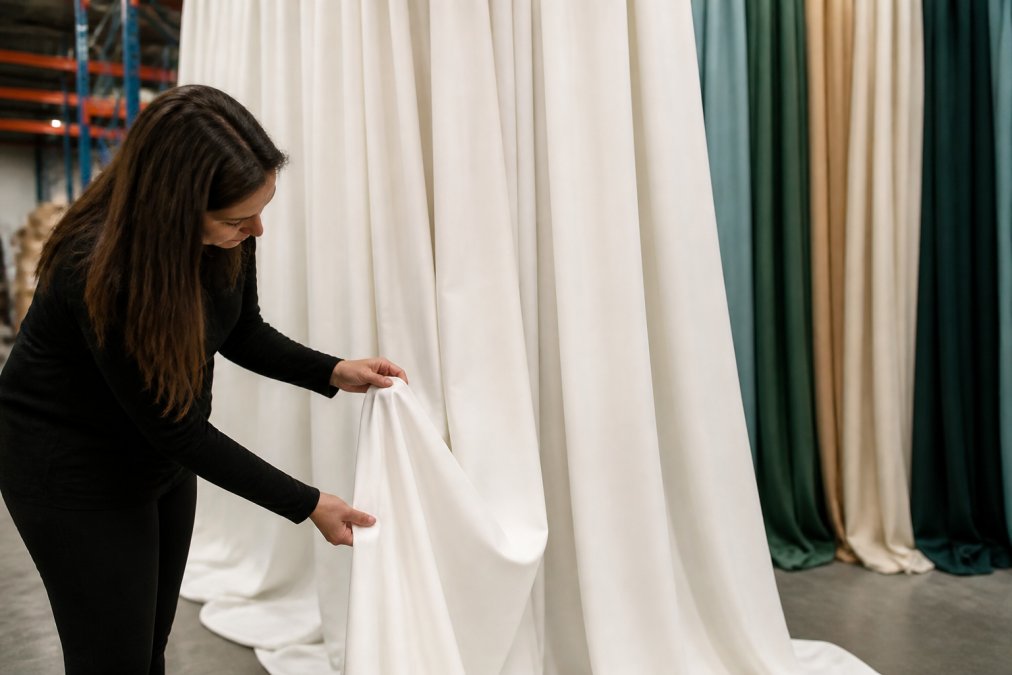
Wrinkled drapes are the single most common complaint in event rental quality disputes. The fix starts long before installation day, in how fabric is transported, stored, and inspected.
Transport, Storage, and Pre-Event Inspection
- Drapes transported on padded rolls, never folded flat under weight
- Stored in climate-controlled space away from direct sunlight
- Each panel inspected for tears, seam separation, and staining
- Fullness checked against the quoted drape fullness ratio
- Hardware sorted and counted against the packing manifest
Steaming is standard practice for velvet and satin, but it must happen after the drape is hung, not before. A panel steamed flat on a table will re-crease the moment it takes its own weight on the pipe.
Professional Pipe and Drape Installation Standards
Professional pipe and drape installation standards exist to prevent the two failure modes that end events early: collapse and sag. Both trace back to rigging, structural integrity, and load limits, and none of the top-ranking draping guides actually explain how those limits are calculated. This section does.
Rigging, Structural Integrity, and Load Limits
Every upright, base plate, and crossbar carries a rated capacity, and the rated capacity is almost always lower than what the hardware can physically hold before it bends. That gap is where failures live. A few mechanics worth knowing before you sign a rigging plan:
- Upright height vs. base plate footprint. A taller upright has more leverage against its base. A base plate sized for a 12-foot upright will not hold a 30-foot run in a high-traffic aisle, even if the upright itself is rated for the height. Match the base plate to the upright height and the aisle traffic, not just to the pipe diameter.
- Crossbar sag under fabric load. Telescopic crossbars sag when overloaded across long spans. The sag is not linear, a crossbar at 80% of its rated span will sag noticeably more than one at 60%, because the deflection curve steepens as the span approaches the limit. When in doubt, add an intermediate upright rather than pushing a single span.
- Fabric weight is the variable planners underestimate. A single velvet panel can be several times heavier than the same panel in sheer (peer-reviewed research). Weigh your fabric before you rig it, and rig for the fabric that arrived, not the fabric the planner imagined. Most sagging drapes were rigged for the lighter option.
- Ceiling height vs. upright inventory. For venues with ceilings that exceed standard drape heights, confirm the vendor's maximum upright height before signing the contract. Not every inventory reaches the tallest spaces, and a vendor who cannot reach the ceiling will substitute a shorter upright and a taller base, which changes the load math.
The Pre-Rig Inspection Sequence
Rigging stability is a process, not a product. Run this sequence before any fabric goes up:
- Confirm venue approval. Many convention centers require weight distribution documentation before any rigging begins. Get the sign-off in writing before the truck is unloaded.
- Count and inspect hardware against the packing manifest. Missing base plates and bent crossbars are the two most common load-in surprises.
- Check every upright for straightness. A bent upright will not seat fully in its base plate, and a partially seated upright is a collapse risk under load.
- Verify base plate weight and footprint against the upright height. If the numbers do not match the plan, stop and re-plan before hanging fabric.
- Hang fabric, then re-check upright plumb. Fabric load can pull an upright slightly out of plumb. A quick re-check after the first panel goes up catches the problem while it is still fixable.
Rigging Stability QA Checklist
- Venue weight distribution documentation approved in writing
- Hardware counted and inspected against packing manifest
- Every upright checked for straightness before seating
- Base plate weight and footprint matched to upright height
- Crossbar span kept below the deflection threshold for the fabric weight
- Intermediate uprights added for long runs rather than pushing a single span
- Upright plumb re-checked after the first fabric panel is hung
- All hardware re-counted and inspected at teardown for damage
Flame Retardant Fabric Requirements for Events
Flame retardant fabric requirements for events are non-negotiable in most venues, and they are enforced at the door. Drapes must carry documented flame retardancy, typically verified through a certificate or an applied treatment record that the venue can inspect (nfpa.org). The practical rule: never assume a drape is compliant because it looks treated. Ask for the documentation before delivery.
What "Documented Flame Retardancy" Actually Means
"Flame retardant" is not a fabric property, it is a documented status. A drape is compliant only if it carries one of the following, and the venue can inspect it on request:
- An inherent flame retardancy certificate from the fabric mill, showing the fabric was manufactured to a recognized flame retardancy standard. This is the strongest form because the treatment cannot wash out or wear off.
- An applied treatment record showing the drape was treated after manufacturing, with the treatment date, the product used, and the expected service life before re-treatment. Applied treatments degrade with cleaning and time, so the record has a shelf life (nist.gov).
- A vendor-issued compliance letter tying the specific drape inventory to the certificate or treatment record. A generic certificate that does not reference the actual panels on the truck is not sufficient at most venues.
How Venues Verify Compliance at Load-In
Verification usually happens in one of three ways, and the method varies by venue:
- Documentation review at the loading dock. The venue's event services team inspects the certificate or treatment record before the truck is unloaded. If the documentation is missing or does not match the panels, the installation is refused on the spot.
- Physical tag inspection. Some venues require a flame retardancy tag sewn into or attached to each panel. A tag that has been removed or faded is treated as non-compliant, even if the fabric was originally treated.
- Field testing. A smaller number of venues conduct a field flame test on a fabric sample. This is uncommon but increasing, and it is the reason a vendor should always carry a spare swatch of the same fabric lot.
The Compliance QA Checklist
- Confirm treatment status at booking, not at load-in
- Request the certificate or treatment record before the delivery date
- Verify the documentation references the specific panels being delivered
- Check that applied treatment records are within their service life
- Confirm each panel carries a flame retardancy tag if the venue requires one
- Carry a spare swatch of the same fabric lot for field testing
- Re-confirm compliance after any cleaning or re-treatment between events
Building a Drape Quality Assurance Checklist
A drape quality assurance checklist turns quality from a hope into a repeatable process. Build it around five stages: order verification, pre-transport inspection, on-site staging, post-installation review, and teardown documentation.
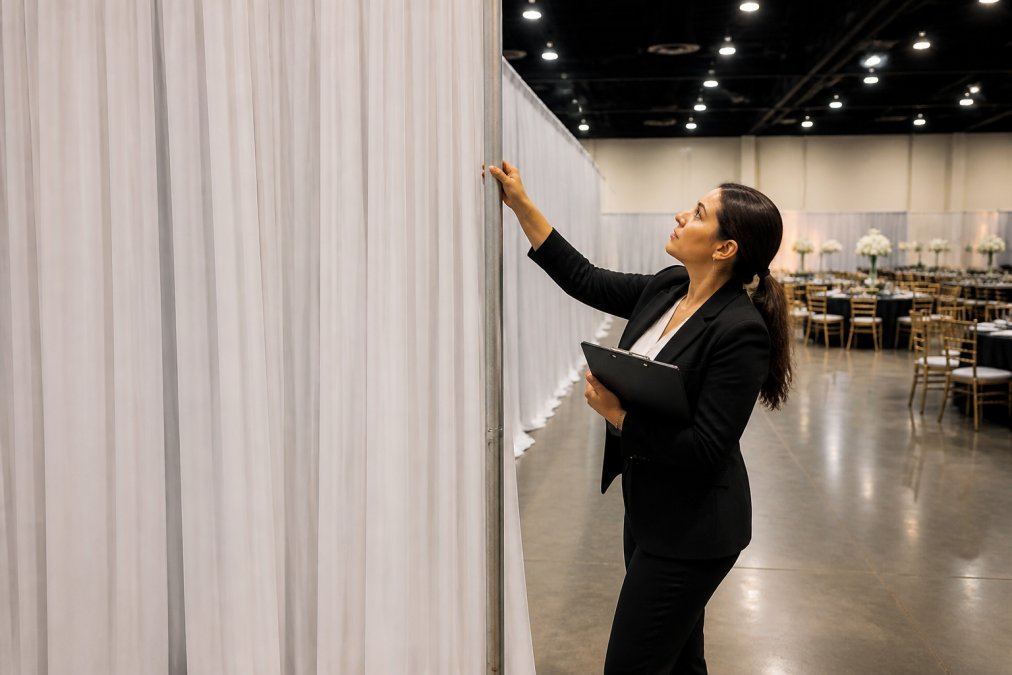
Budget-to-Quality Ratio: Where to Invest and Where to Save
Spend on the elements the audience sees and touches: focal backdrops, entry walls, and any drape that appears in photographs. Save on hidden structural elements and room partitioning that no one inspects closely. Reusable backdrops and durable hardware carry their cost across multiple events, which lowers the effective per-event spend over time. Pricing depends on quantity, dates, and delivery, so request a quote rather than estimating from a per-panel figure.
Sustainability and Lifecycle of Reusable Drapes
Reusable drapes are the most sustainable line item in an event budget, provided they are maintained correctly. Drape maintenance extends lifecycle: proper cleaning between events, rotation of high-wear panels, and repair of seam damage before it spreads. Pre-owned hardware markets extend this further, letting planners scale inventory without buying new. The lifecycle math favors buying quality once and maintaining it, rather than replacing cheap fabric every season.
Conclusion
The hardest part of drape quality assurance is not the checklist itself. It is finding a vendor whose inventory, documentation, and installation standards hold up under real event conditions. Event Drape Rental maintains over 100 colors and 6 fabric materials, with drapes ranging from 12 to 30 feet in height and both DIY and professional installation options. Request a quote from Event Drape Rental and get professional-grade drapery matched to your event.
Frequently Asked Questions
What are the best fabrics for versatile event draping?
Satin, velvet, and sheer fabrics each serve different purposes. Satin reflects light well for luxury backdrops, velvet adds textural dimension and blocks light bleed, and sheers create soft room partitioning. For versatility across venues, choose a medium-weight fabric with wrinkle resistance and high opacity. Event Drape Rental offers a wide selection of fabric materials and colors, so you can match corporate branding and wedding aesthetics from the same inventory without compromising drape fullness or fabric weight.
How do you ensure drape quality during event installation?
Start with a pre-installation inspection: check every panel for tears, stains, and seam separation before it goes on the upright. Confirm crossbar tension and base plate stability, then verify drape fullness and hem alignment from the audience sightline. Photograph the finished setup for your records. Professional pipe and drape installation standards include checking that no fabric touches the floor and that all rigging points are rated for the load. Ask your rental provider for their inspection documentation before delivery day.
What is the difference between IFR and FR rated event drapes?
IFR stands for inherently flame retardant, meaning the flame-resistant properties are built into the fiber itself and cannot wash out or wear off. FR treated fabrics have a chemical finish applied after manufacturing, which can diminish over time with cleaning and handling. For events, always request documentation showing the fabric meets flame retardant fabric requirements for events. IFR fabrics typically cost more but hold their certification longer, which matters for venues that require proof of compliance at load-in.
How can pipe and drape transform a corporate event space?
Pipe and drape systems convert open industrial event space into defined zones within hours. You can partition a trade show floor into branded booth areas, hide unsightly walls behind custom backdrops, or create intimate meeting rooms inside a large hall. The key is matching drape height to ceiling clearance (12 to 30 feet covers most venues) and choosing fabric opacity that controls light bleed. Modular uprights and telescopic crossbars let one inventory serve multiple room layouts across a multi-day conference.
What are the best practices for avoiding wrinkled drapes in rentals?
Request that drapes ship on hangers or rolled on tubes rather than folded in bins. When they arrive, hang them immediately and let gravity work out minor creases for 24 hours before the event. For stubborn wrinkles, use a handheld steamer on low heat, never an iron directly on velvet or satin. Confirm your rental provider inspects and steams every panel before it leaves their warehouse. Ask about their wrinkle resistance standards and whether they re-steam between multi-day events.
How do you choose the right drape height for different venues?
Measure the venue's ceiling clearance at the highest and lowest points, then subtract at least 6 inches for hardware and rigging. Standard heights run 12 to 30 feet; converted warehouses and atriums often need the taller end. For room partitioning, 8 to 12 feet creates adequate visual separation without overwhelming the space. Always confirm your rental provider stocks the height you need in the color and fabric you want, since mixing heights across a single wall creates visible inconsistencies.