 listicle
Flame Retardant Event Drapes for Rent: 2026 Guide
Table of Contents
- Why Flame Retardant Event Drapes Are Non-Negotiable
- IFR vs FR Fabric for Events: Which One Do You Actually Need?
- Pipe and Drape Fire Safety Requirements Explained
- Fabric Types, Fullness, and Drape Aesthetics
- Flame Retardant Drapes for Every Event Application
- How to Calculate Cost of Event Draping Per Square Foot
- Rigging, Hardware, and Installation Requirements
- Event Drape Rental Options: Quick Reference
- Frequently Asked Questions
Last Updated: August 18, 2026
Why Flame Retardant Event Drapes Are Non-Negotiable
Flame retardant event drapes for rent are a legal requirement at virtually every indoor event venue. Fire codes enforced by local fire marshals require that all soft goods used in public assembly spaces meet specific flame resistance standards. Skip this requirement and you risk permit denial, forced shutdown mid-event, or personal liability if a fire incident occurs.
Flame retardant event drapery is fabric that resists ignition and self-extinguishes when the flame source is removed. This behavior is either built into the fiber at the manufacturing stage or applied as a chemical treatment after weaving.
The governing standard is NFPA 701 Standard Methods of Fire Tests for Flame Propagation of Textiles and Films, which defines the test methods that certify whether a fabric is safe for use in public spaces. Any drape used at a permitted event should carry documentation proving it passed NFPA 701 testing. Without that paperwork, a fire marshal can order the drapes removed on-site.
Most event planners confuse "flame resistant" and "flame retardant", they don't mean the same thing. The difference determines how long your drapes stay compliant, which directly affects your rental decision.
IFR vs FR Fabric for Events: Which One Do You Actually Need?
The choice between IFR and topically treated FR fabric is the most consequential decision in event draping.
Inherently Flame Retardant (IFR) Fabrics
Inherently Flame Retardant (IFR) fabric has fire-resistant properties built into the polymer structure of the fiber itself during manufacturing. The flame resistance cannot wash out, wear off, or degrade over normal use.
For rental inventory, IFR is the professional standard. A drape panel that gets installed, struck, folded, shipped, washed, and reinstalled dozens of times per year will retain its certification without any retreatment.
Common IFR fabric types used in event draping include Poly Premier, a lightweight polyester ideal for corporate backdrops; Velour, a heavier pile fabric favored for stage curtains; and Sheer fabrics, lightweight translucent panels used for layering effects.
Topically Treated FR Fabrics
Topically treated FR fabric starts as a standard textile and receives a chemical flame-retardant coating applied after weaving. The treatment is effective when new but degrades with washing, humidity exposure, and general wear. Most certification bodies require retreatment every one to three years.
For rental applications, topically treated fabric creates a compliance problem. The certification is time-sensitive, and a drape that passed testing six months ago may no longer be certifiable today if it has been laundered multiple times since. Reputable rental providers avoid topically treated FR fabric in their core inventory.
| Feature | IFR Fabric | Topically Treated FR |
|---|---|---|
| Compliance durability | Permanent, does not degrade | Temporary, degrades with washing |
| Best for rentals | Yes, no retreatment needed | Risky, requires retreatment tracking |
| NFPA 701 eligible | Yes | Yes, when freshly treated |
| Certification risk | Minimal | High over time |
Pipe and Drape Fire Safety Requirements Explained
Fire safety compliance for pipe and drape systems is governed by NFPA 701 fabric standards and local fire code enforcement. The International Fire Code requirements for public assembly occupancies sets baseline rules that most jurisdictions adopt, but local fire marshals have authority to impose stricter requirements.
For any permitted event, the fabric certification is only part of compliance. The full picture includes how the drape system is installed, anchored, and maintained during the event.
Fire Marshal Inspection Checklist
A fire marshal conducting a pre-event inspection will typically verify:
- Fabric certification tags are physically attached to each drape panel or a master certificate is on file
- NFPA 701 test documentation is available, including the test date and certifying laboratory
- Drape panels do not contact heat sources, lighting fixtures, electrical panels, or HVAC vents
- Egress paths are unobstructed, no drape panels block emergency exits, fire extinguisher access, or sprinkler heads
- Hardware is stable, base plates are weighted appropriately and uprights are not at risk of tipping
- Drape does not pool on the floor, fabric touching the floor creates both a trip hazard and a fire spread risk
- No open flames near fabric, candles, chafing fuel, or pyrotechnics must maintain required clearances
Fabric Types, Fullness, and Drape Aesthetics
The visual quality of a pipe and drape installation depends on fabric selection and fullness ratio.
Fullness refers to the ratio of fabric width to the span it covers. A flat panel uses a 1:1 ratio, one foot of fabric for every foot of span. A fully gathered panel at 2:1 fullness uses two feet of fabric for every foot of span, creating visible folds and depth.
Common fullness ratios and their applications:
- 100% fullness (1:1 ratio): Flat, taut panels. Works well for printed backdrops and photo walls.
- 150% fullness (1.5:1 ratio): Light gathering with visible soft folds. The most common choice for corporate events.
- 200% fullness (2:1 ratio): Full, luxurious gathering. Standard for wedding backdrops and gala stage surrounds.
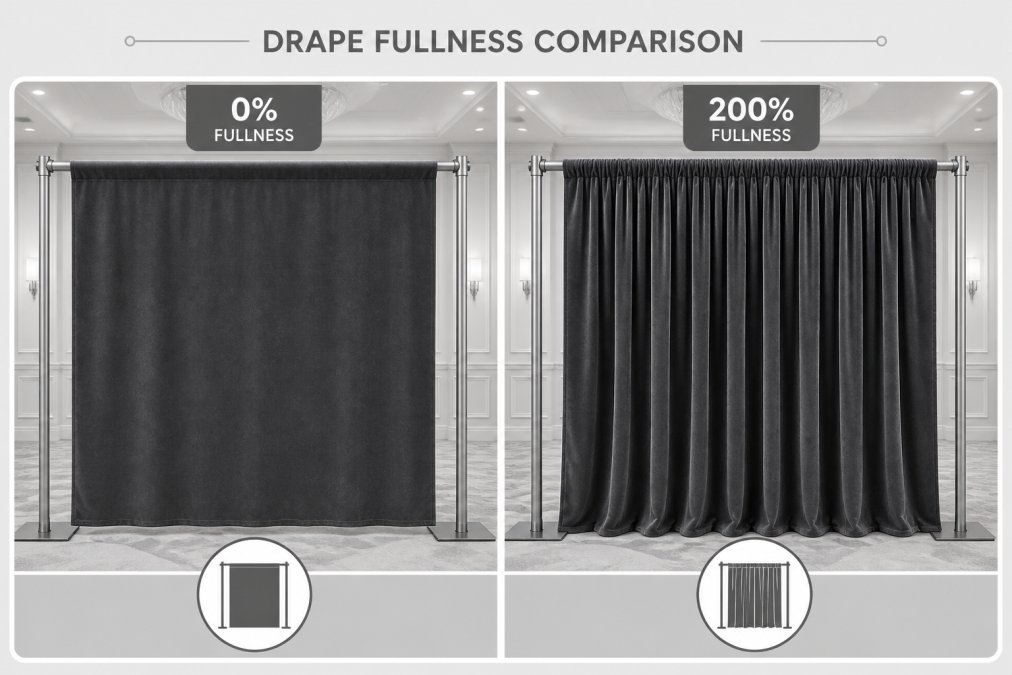
Fabric weight affects how fullness reads. Heavier fabrics like velour fall in clean, defined folds. Lighter fabrics like Poly Premier create softer gathering. Sheer fabrics at high fullness create an ethereal, layered effect ideal for ceiling treatments.
Always specify your fullness ratio when requesting a quote. A provider quoting 100-foot runs at 100% fullness is quoting roughly half the fabric quantity of one quoting at 200% fullness.
Flame Retardant Drapes for Every Event Application
Flame retardant event drapes for rent serve different functional and aesthetic purposes depending on the event type.
Weddings and Private Celebrations
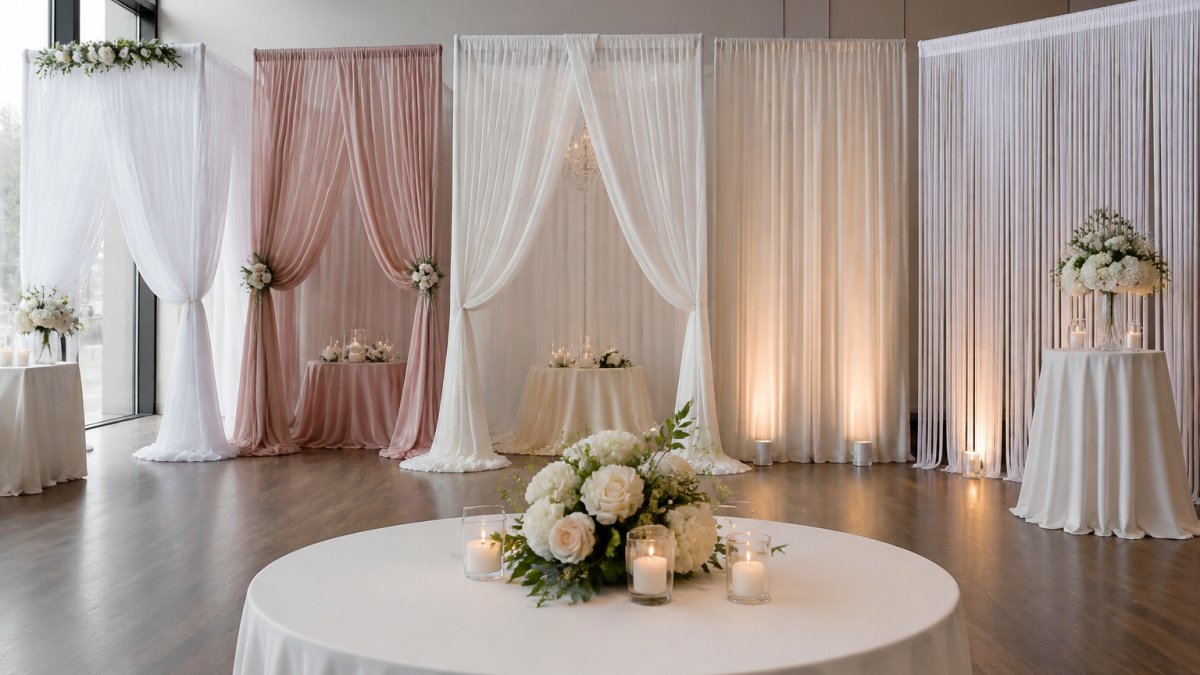
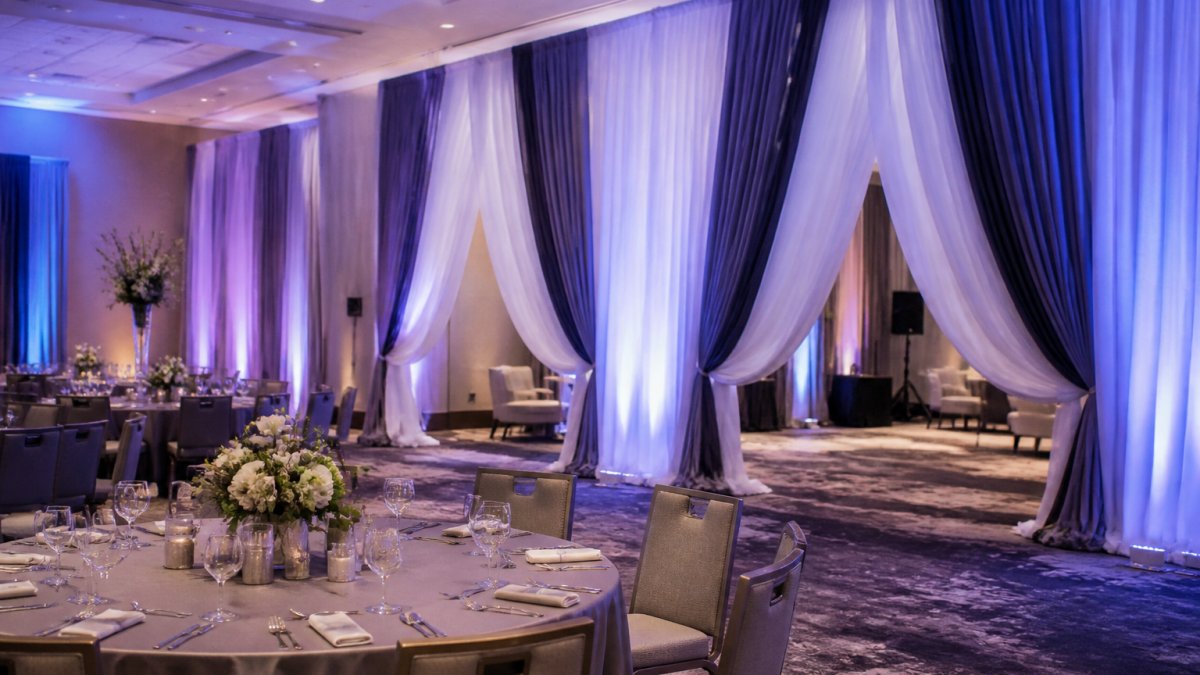
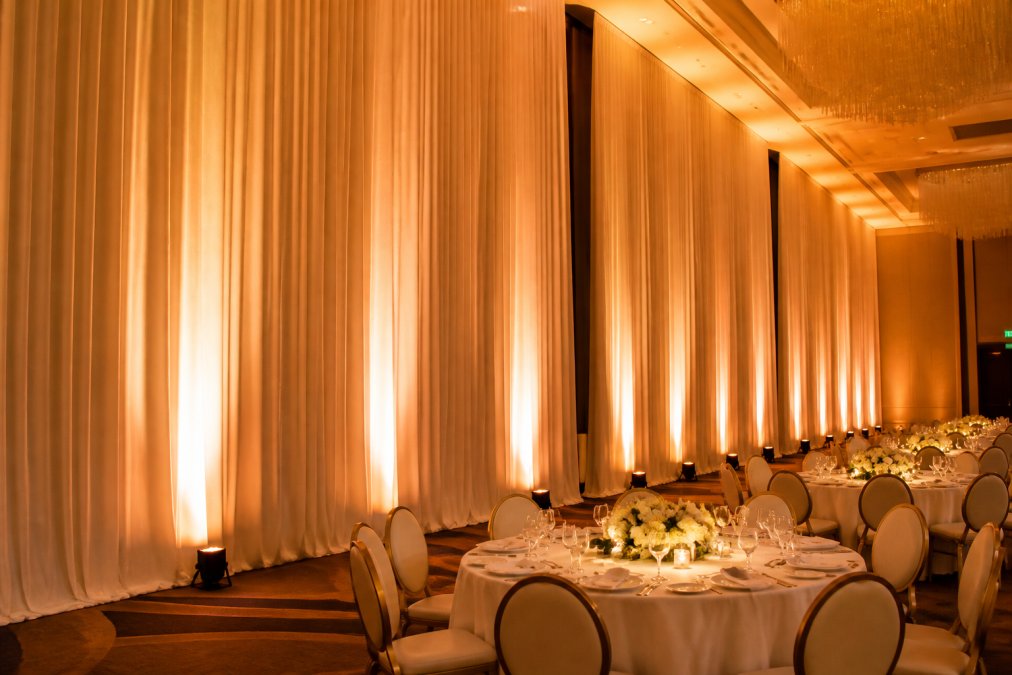
Weddings demand the most from drape aesthetics. Ceremony backdrops, head table surrounds, ceiling treatments, and room dividers all require fabric that photographs beautifully under mixed lighting. Velour at 200% fullness creates the classic, opulent backdrop look. Sheer panels layered over solid color backdrops add dimension and catch light exceptionally well. Heights typically range from 8 to 16 feet for ceremony backdrops.
Corporate Events, Galas, and Conferences
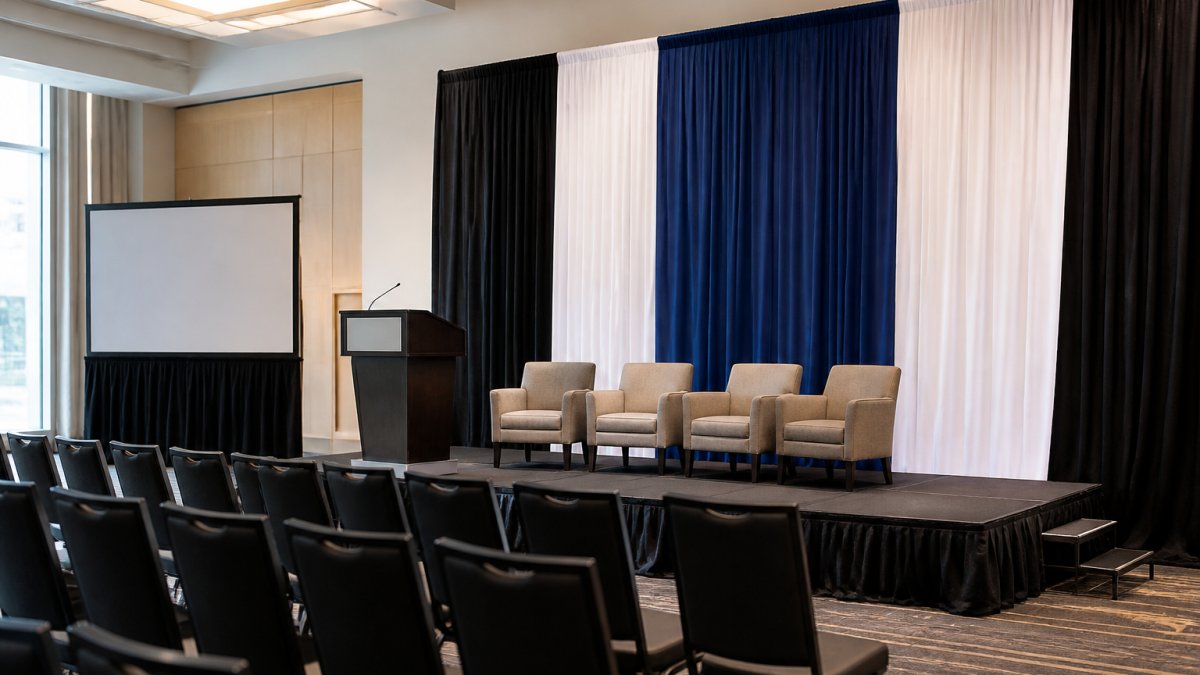
Corporate applications prioritize clean lines, brand alignment, and fast installation. Poly Premier at 150% fullness is the most common specification. The fabric's matte finish minimizes glare under stage lighting, and the moderate fullness reads as polished without being overtly theatrical. Heights from 12 to 20 feet cover most hotel and convention center applications.
Trade Show Booths and Exhibitions
Trade show draping defines booth boundaries and provides a branded backdrop for product displays. Pipe and drape systems are typically set at 8 to 10 feet for back walls and 3 to 4 feet for side dividers. Fabric is usually hung flat or at minimal fullness to maximize the usable wall surface for signage. NFPA 701 compliance is non-negotiable at major trade shows.
Stage Productions and Performances
Stage applications place the most demanding requirements on both fabric and hardware. Velour is the industry standard for stage soft goods. Its pile surface absorbs light rather than reflecting it, creating the deep, neutral background that stage lighting designers require. Black velour is the most common specification. Drape heights for stage applications often exceed what standard pipe and drape hardware can reach, requiring dedicated rigging points.
How to Calculate Cost of Event Draping Per Square Foot
Understanding how to calculate cost of event draping per square foot helps you budget accurately and compare quotes on an apples-to-apples basis.
The calculation starts with total fabric area required, determined by your fullness ratio:
Total fabric width needed = Linear feet of coverage × Fullness ratio
For example: a 100-foot perimeter at 150% fullness requires 150 feet of fabric panels. At a standard 10-foot height, that's 1,500 square feet of fabric.
Key variables that affect per-square-foot cost include fabric type, drape height, fullness ratio, delivery and installation, rental duration, and quantity.
Submit a detailed request for quote with your venue dimensions, event date, fabric preference, and fullness requirements. Event Drape Rental provides quote-based pricing that accounts for all these variables.
Rigging, Hardware, and Installation Requirements
Pipe and drape systems are freestanding structures. Understanding how they work and where their limits are prevents both safety incidents and aesthetic failures.
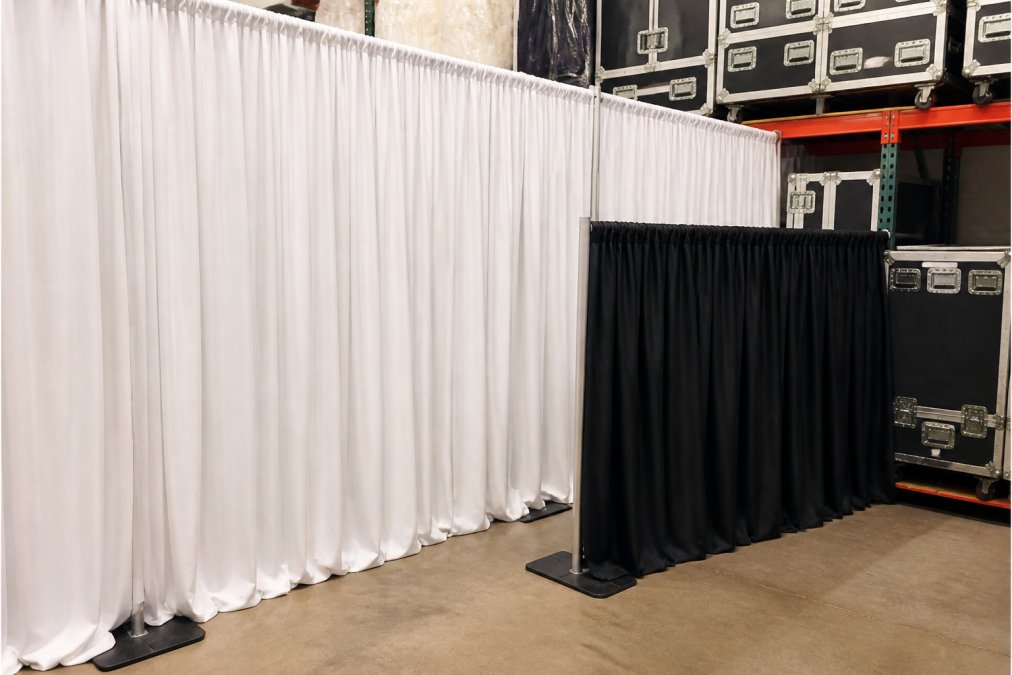
A standard pipe and drape system consists of base plates, telescopic uprights, crossbars, and drape panels. Base plates provide the foundation. Uprights extend vertically to the desired height. Crossbars span horizontally between uprights and carry the drape panels.
According to OSHA guidelines on temporary structures and load management at events, freestanding temporary structures must be evaluated for lateral stability under expected load conditions, including fabric weight and air movement from HVAC systems.
Drape weight and rigging stability considerations:
- Base plate weight: Heavier bases provide more stability. For tall uprights above 12 feet, weighted bases or sandbag ballast are required.
- Upright height limits: Standard telescopic uprights typically reach 12 feet. Heights above 12 feet require extended uprights or dedicated rigging points.
- Crossbar span: Standard crossbars run 4 to 10 feet. Longer spans require additional support to prevent sag.
- Fabric weight per linear foot: Heavier fabrics like velour exert more lateral force on the upright system in air-conditioned spaces.
For installations above 16 feet, freestanding pipe and drape systems reach their practical limit. Drapes at 20 to 30 feet require venue-provided rigging points, typically motor hoists or dead-hang rigging from structural beams.
DIY installation is practical for standard configurations at 8 to 12 feet. Taller or more complex installations benefit from professional setup for both safety and quality.
Sustainability note: Renting IFR drapes rather than purchasing disposable alternatives significantly reduces per-event textile waste. IFR fabric's durability means a single panel can be used across hundreds of events over many years. As the EPA's guidance on sustainable event planning practices notes, extending the useful life of textiles through shared-use models is one of the most effective waste reduction strategies available to event organizers.
Event Drape Rental Options: Quick Reference
| Application | Recommended Fabric | Typical Height | Fullness Ratio | Installation Type |
|---|---|---|---|---|
| Wedding ceremony backdrop | Velour or Poly Premier | 8-16 ft | 150-200% | Professional recommended |
| Corporate conference backdrop | Poly Premier | 12-20 ft | 150% | Professional recommended |
| Trade show booth back wall | Poly Premier | 8-10 ft | 100% flat | DIY or professional |
| Gala stage surround | Velour | 16-20 ft | 200% | Professional required |
| Stage production curtains | Velour | 20-30 ft | 150-200% | Rigging required |
| Room divider | Poly Premier or Sheer | 8-12 ft | 100-150% | DIY suitable |
Flame retardant event drapes for rent serve a function that goes beyond aesthetics, they are a fire safety requirement, a legal compliance obligation, and a direct reflection of your event's production quality. The difference between a venue-ready installation and one that fails inspection comes down to fabric certification, correct hardware, and proper installation. Event Drape Rental carries a full inventory of IFR-certified drapes in over 100+ colors and 6 different fabric materials, with both DIY and professional installation options to fit your timeline and budget.
Frequently Asked Questions
What does IFR mean for event drapes?
IFR stands for Inherently Flame Retardant. The fire resistance is built into the fiber itself during manufacturing, so it cannot wash out or wear off over time. This is different from topically treated FR fabrics, which are sprayed with a chemical coating that can degrade. For high-traffic events or venues where fire marshals require documentation, IFR fabric is the more reliable choice and is what NFPA 701 compliance testing is designed to verify.
Are all event drapes required to be flame retardant?
Most venues and jurisdictions require event drapery to meet NFPA 701 flame retardant standards, particularly for public gatherings, trade shows, and events with open flames or pyrotechnics nearby. Fire marshals can inspect and remove non-compliant drapes before or during an event. Requirements vary by state and venue type, so confirm with your venue and local fire authority before your event date. Reputable rental providers supply flame certification documentation with every order.
How do I verify the fire rating of rental drapes?
Ask your rental provider for a flame certificate or fire retardant certification document for each drape in your order. This certificate should reference NFPA 701 test compliance and identify the fabric type. For IFR fabrics, the certification is permanent and tied to the fabric specification. For topically treated fabrics, check the treatment date, certifications typically need renewal after laundering or after a set period. Your fire marshal may request this documentation during venue inspection.
How much does it cost to rent flame retardant drapes per square foot?
Rental pricing for flame retardant drapes depends on fabric type, drape height, quantity ordered, delivery distance, and whether you choose DIY pickup or professional installation. There is no single industry-standard rate per square foot. Providers calculate quotes based on your specific layout, panel count, and service level. For an accurate figure, measure your total linear footage of coverage, note your ceiling height, and request a quote directly, most providers can turn around an estimate quickly with those details.
Do fire marshals require documentation for event drapery?
Yes, fire marshals can and do request flame retardant certification documentation during venue inspections, especially at large public events, trade shows, and venues with occupancy over a set threshold. Documentation typically includes the fabric's NFPA 701 test certification and, for treated fabrics, proof of the treatment date. Having this paperwork on-site at load-in prevents last-minute compliance issues. A reliable rental provider sends the certification with your drape delivery automatically.
Getting the draping right on a high-profile event is not the place to cut corners or guess at compliance. Submit a detailed Request for Quote to Event Drape Rental with your venue dimensions, event date, and fabric preferences, and receive a quote that covers fabric type, fullness, height, and installation, so you know exactly what you're getting before the truck arrives.
This article was written using GrandRanker