 ultimate-guide
How to Plan Event Decor Logistics: Step-by-Step Guide
Table of Contents
- Define Event Objectives and Decor Goals
- Conduct Venue Selection and Site Inspection
- Create a Detailed Event Timeline and Load-In Schedule Template
- Design Your Floorplan and Space Layout
- Plan Infrastructure and Rental Equipment Needs
- Build an Event Decor Installation Checklist and Assign Roles
- Establish Contingency Planning and Risk Mitigation
- Manage Load-Out and Strike Workflows
- Frequently Asked Questions
Last Updated: August 26, 2026
Define Event Objectives and Decor Goals
Your event objectives determine everything that follows: the scale of your decor, the complexity of your installation timeline, the equipment you'll need, and ultimately the resources required for load-in and strike.
Ask yourself what your event needs to accomplish. Are you hosting a corporate gala where decor reinforces brand identity? A trade show booth where draping defines your space? A wedding where the aesthetic transforms a raw venue into something intimate? Each scenario demands different approaches to event decor logistics.
Document your specific decor goals in writing, noting the visual atmosphere, color palette, branding requirements, areas needing transformation, and any technical constraints the venue imposes. Get client approval before moving forward.
Conduct Venue Selection and Site Inspection
A venue site inspection identifies the constraints and opportunities that shape your entire event decor logistics plan. Schedule a dedicated visit with the venue manager, your installation team, and anyone involved in technical setup. Bring a measuring tape, camera, and notebook.
Measure critical dimensions: ceiling heights where you'll hang drapes, wall widths for backdrops, column locations, and the distance from the loading dock to your setup area. These measurements directly impact your equipment needs and installation timeline.
Identify infrastructure limitations. Does the venue have adequate electrical outlets? Are there structural elements that complicate drape installation? What's the condition of walls and surfaces? Get these constraints in writing from the venue.
Assess load-in logistics during your site visit. Where's the loading dock? How wide are hallways and doorways? Can you move equipment directly to your setup area, or will you need to navigate tight corridors? Is there a service elevator? These details determine how long your load-in takes and what equipment you can physically move into the space.
Check for fire safety considerations. Where are the fire exits? Are there fire suppression systems overhead that might interfere with drape installation? According to NFPA fire safety standards for event venues, certain fabric types must meet specific fire ratings. Confirm your venue's requirements before finalizing your decor selections.
Create a Detailed Event Timeline and Load-In Schedule Template
Your event timeline coordinates vendor deliveries, installation windows, staff availability, and client walkthroughs. A weak timeline creates cascading delays; a detailed one prevents them.
Work backward from your event start time. If your gala begins at 6 PM and you need the space completely finished by 5:30 PM, that's your hard deadline. Professional installation of pipe and drape typically requires 2-4 hours depending on complexity and space size (peer-reviewed research).
Build your timeline backward from that completion deadline. Add delivery time, most rental companies require 24-48 hours notice. Account for unloading and inspecting equipment before installation begins, typically 30-60 minutes.
Create a master timeline document that includes:
- Equipment delivery date and time window
- Load-in start time and estimated completion time
- Client walkthrough or approval window (if applicable)
- Setup crew arrival time and break schedule
- Final walkthrough and any touch-up time
- Load-out start time (scheduled for after the event ends)
Share this timeline with all stakeholders: the venue, your installation crew, your client, and any other vendors involved. Get written confirmation that everyone can meet these deadlines. Include 15-30% contingency time in your timeline.

Design Your Floorplan and Space Layout
Your floorplan translates your decor vision into a spatial blueprint that guides installation and ensures your event decor logistics actually work in the physical space.
Start with a scaled drawing or digital layout of your venue. Mark permanent features: walls, columns, doors, windows, electrical outlets, and any architectural elements that affect drape placement. Overlay your decor plan on this floorplan, marking the exact dimensions and placement of each drape section.
Consider traffic flow and sightlines. If you're dividing a large space with drapes, ensure people can navigate clearly. Calculate the total linear footage of drapes you need. Event Drape Rental offers drapes ranging from 12 to 30 feet in height, so your floorplan must account for these standard heights and your specific venue dimensions.
Identify mounting points and hardware requirements. Where will you attach drape hardware? Are you using wall-mounted systems, freestanding pipe and drape, or ceiling-mounted solutions? Your floorplan should specify which method applies to each drape section.
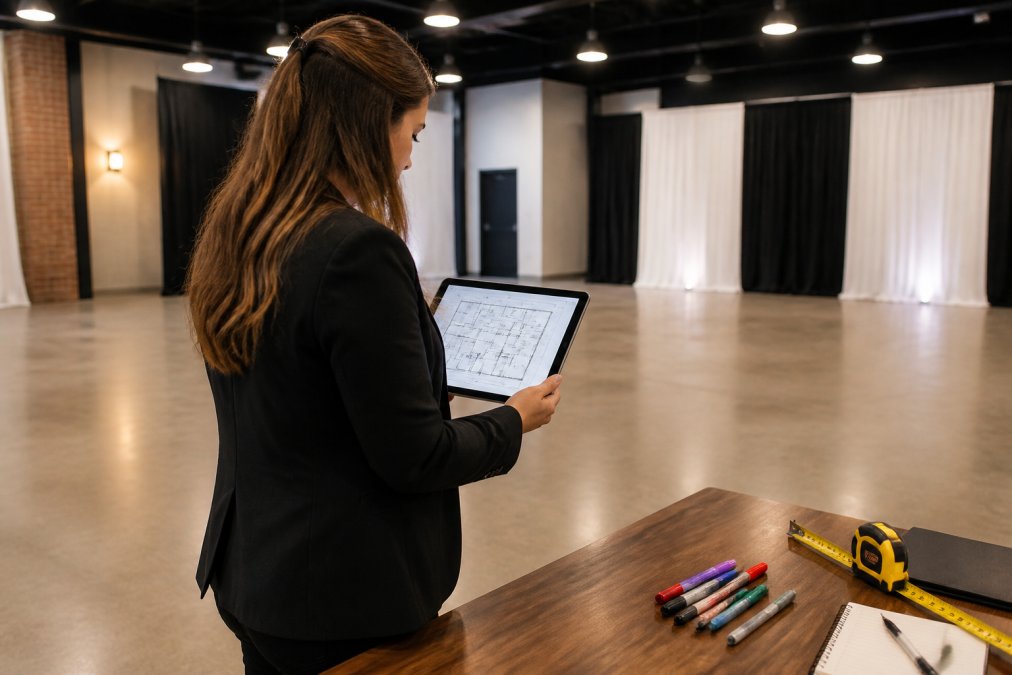
Share your floorplan with your installation team well before load-in day. This gives them time to identify any questions or logistical concerns.
Plan Infrastructure and Rental Equipment Needs
Infrastructure planning determines what equipment you need to rent, how much crew time your installation requires, and whether your event decor logistics are feasible in your timeline.
List every drape section from your floorplan, along with its dimensions and mounting method. For each section, determine the equipment required: pipe and drape stands, ceiling-mounted hardware, wall brackets, or other fixtures.
Assess your fabric material needs based on your venue and event type. Sheer materials create elegant backdrops and allow light to pass through. Opaque fabrics provide complete room division and hide unsightly areas.
Determine your color requirements. Event Drape Rental maintains an inventory with over 100 colors available. Confirm that your specific color choices are in stock or available within your timeline.
Assess lighting infrastructure. Will your drapes need to be lit? Uplighting behind drapes creates dramatic effects but requires electrical access and lighting equipment. If your venue doesn't have built-in lighting infrastructure near your drape locations, you'll need to rent lighting equipment.
Calculate crew requirements based on your equipment needs and installation timeline. A simple backdrop might require 2-3 crew members and 1-2 hours. A full room transformation could require 4-6 crew members and 4-6 hours.
Build an Event Decor Installation Checklist and Assign Roles
A detailed installation checklist transforms your plan into actionable tasks and prevents critical steps from being missed during load-in day. Assign specific roles so everyone knows their responsibilities.
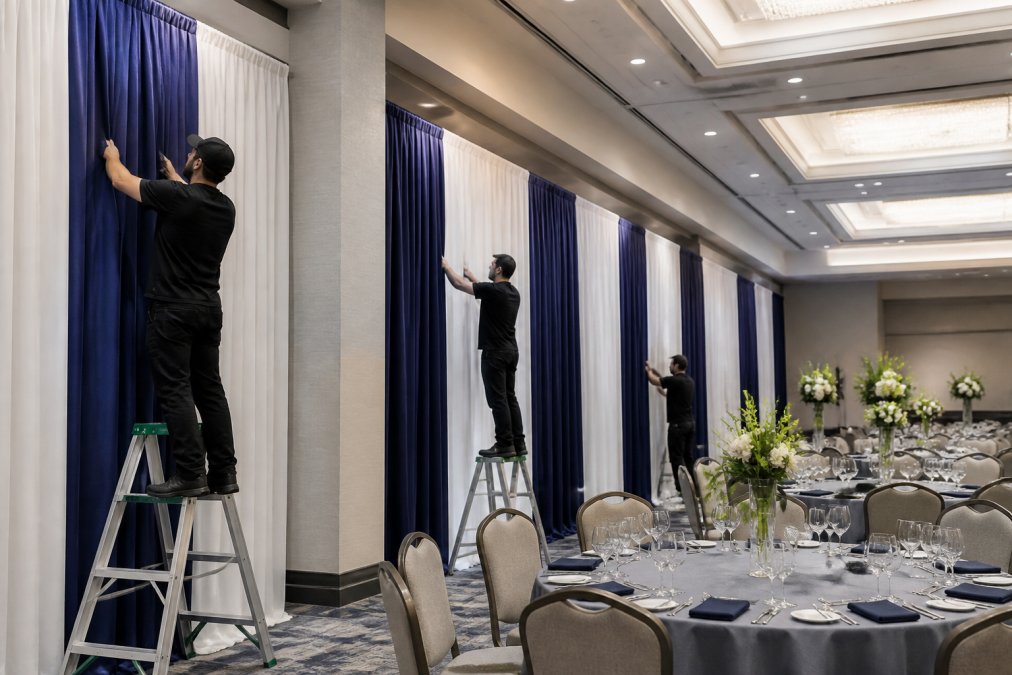
Create a checklist that covers every phase of installation: equipment arrival and inspection, setup of pipe and drape stands, drape hanging and securing, lighting setup (if applicable), final walkthrough, and client approval. Include specific details for each task.
Assign a project lead who owns the overall installation timeline and coordinates crew activities. Assign specific crew members to specific tasks: one person manages equipment arrival and inspection, another manages pipe and drape installation, another manages lighting if applicable.
Build your checklist to include quality checks at each stage. After equipment arrives, inspect for damage before installation begins. After drapes are hung, verify they're level, secure, and aligned with your floorplan.
Include a pre-event walkthrough in your checklist. Before the first guest arrives, walk the entire space with your client or event manager. Verify that the decor matches the vision, that all drapes are properly hung and secured, and that the space is clean and ready.
Finding Draping Services Near Me
When you're ready to execute your event decor logistics plan, finding a reliable draping service partner is critical. You need a provider who understands your timeline, delivers quality materials, and can handle your specific installation requirements.
Event Drape Rental offers both DIY rental options and professional installation services. If you're managing installation yourself, you rent the equipment and handle setup with your own crew. If you're opting for professional installation, Event Drape Rental handles the complete setup, ensuring your drapes are hung correctly and your timeline stays on track.
When evaluating draping service providers, ask about their inventory depth, delivery capabilities, and installation experience. Can they deliver to your venue on your required date? Do they have your specific color and fabric requirements in stock? Have they worked with your venue before?
Confirm their quality standards. How do they inspect drapes before delivery? What condition guarantee do they provide? If drapes arrive damaged or wrinkled, how do they remedy the situation?
Discuss installation timelines and crew size. How long do they typically require for your type of setup? Can they accommodate rush timelines if needed? What's their contingency plan if a crew member becomes unavailable?
Establish Contingency Planning and Risk Mitigation
Event decor logistics rarely proceed exactly as planned. Weather delays delivery, equipment arrives damaged, a crew member gets sick, or an unforeseen venue issue emerges. Contingency planning is how you handle these situations without derailing your event.
Identify your key risks: delivery delays, equipment damage, crew unavailability, venue access issues, fire safety complications, or installation problems. For each risk, develop a mitigation strategy.
For delivery delays, build extra time into your timeline. If your event is on Saturday, schedule delivery for Thursday, giving you Friday as a buffer day. For equipment damage, inspect everything immediately upon arrival and request replacement if needed. For crew unavailability, maintain a backup crew list. For venue access issues, confirm access procedures during your site visit and get written confirmation. For fire safety complications, confirm your venue's requirements during planning. According to National Fire Protection Association guidelines for event venues, certain configurations require specific clearances from fire exits and sprinkler systems.
Create a contingency response document that outlines who to contact if specific issues arise. Having these decisions made in advance, rather than making them in crisis mode, keeps your event decor logistics on track.
Manage Load-Out and Strike Workflows
Load-out, removing drapes and equipment after your event ends, is often overlooked in planning. But efficient strike workflows protect your equipment, maintain your rental relationship, and clear the venue promptly.
Schedule your load-out before your event. When will the event end? When will guests depart? When can your crew begin removing drapes and equipment? Coordinate this timing with the venue.
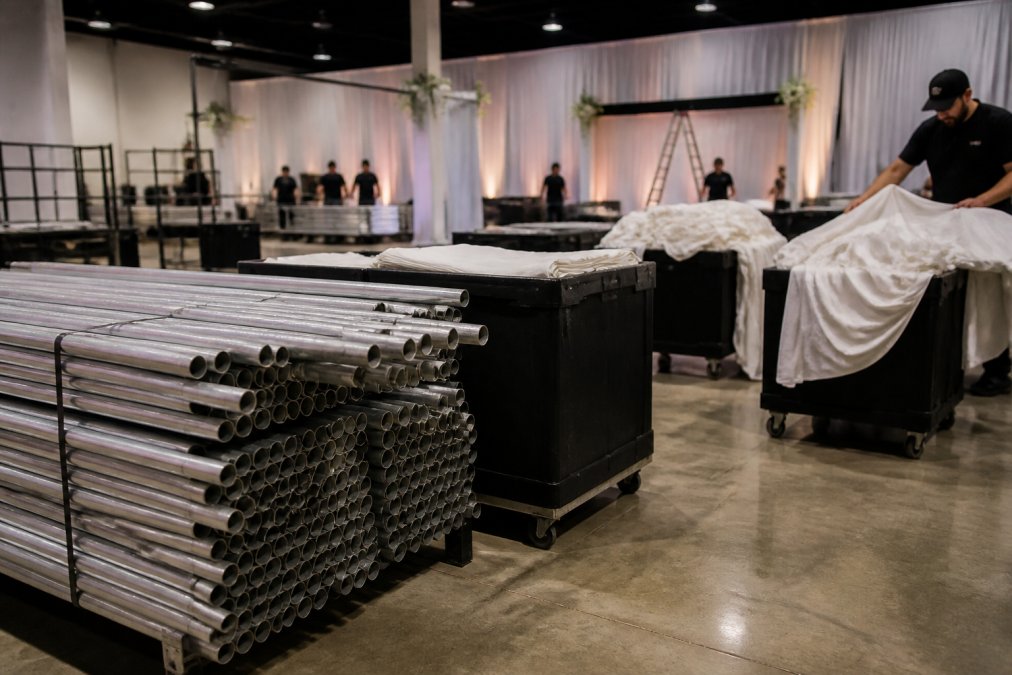
Create a strike checklist that mirrors your installation checklist in reverse. Remove lighting fixtures first (if applicable), then carefully take down drapes and fold them properly. Disassemble pipe and drape stands, organizing components so they pack efficiently. Inspect all equipment as you remove it, noting any damage that occurred during the event.
Assign specific crew members to specific removal tasks. One person manages drape removal and folding, another manages stand disassembly, another manages equipment packing and inventory.
Develop an inventory management system for strike. As equipment is removed and packed, check it off against your rental inventory list. This confirms that everything is accounted for and prevents items from being left behind.
Protect your equipment during packing. Fold drapes carefully to prevent wrinkles. Use protective covers or bags for delicate materials. Pack stands and hardware so they don't shift during transport.
Confirm your load-out timeline with the venue. How late can you remain in the space for strike? Do they have specific procedures for equipment removal? Coordinating these details prevents conflicts and ensures smooth load-out.
Planning event decor logistics is fundamentally about coordination: aligning your vision with your venue, coordinating timelines with your crew, and coordinating equipment delivery with your installation schedule. The difference between an event that runs smoothly and one that doesn't often comes down to planning rigor before load-in day.
Event Drape Rental understands this complexity. With drapes available in over 100 colors and ranging from 12 to 30 feet in height, plus both DIY rental and professional installation options, we provide the flexibility to match your specific event decor logistics needs. Whether you're managing a corporate gala, a trade show booth, or a wedding, our team can help you execute your vision on time and within your operational constraints. Request a quote today and let us help you transform your venue into exactly what you envision.
Frequently Asked Questions
What's the difference between event planning and event logistics?
Event planning focuses on the overall vision, goals, and creative direction of your event. Event logistics handles the operational execution: timelines, vendor coordination, equipment delivery, installation workflows, and load-in/load-out schedules. For event decor logistics specifically, you're managing how drapes, pipe, and hardware move from inventory to venue to installation to removal. Both work together, but logistics is the tactical backbone that makes the creative vision actually happen on the ground.
How do I create an event load-in schedule template that actually works?
Start with your event start time and work backward. Allocate 2-4 hours minimum for decor installation, depending on complexity. Break it into phases: setup crew arrival, equipment unloading, pipe assembly, drape hanging, final adjustments. Include buffer time between phases. Assign specific roles (crew lead, installers, quality check). Document arrival times, parking, access points, and contact numbers. Share the schedule with your venue contact and all vendors 48 hours before the event. A template should be editable, specific to your venue layout, and include contingency time slots.
What should I include in an event decor installation checklist?
Your checklist should cover: pre-installation (equipment inventory, crew roles, safety gear), installation phases (pipe assembly, drape hanging, securing anchors), quality checks (wrinkles, color accuracy, secure fastening), and post-installation (backup power, lighting integration, accessibility verification). Include fire safety compliance checks if required by your venue. Assign ownership for each item, who verifies it's complete. Use a digital format so the on-site team can check items off in real time. This prevents missed details and creates accountability.
How do I find qualified draping services near me?
Search for event rental companies that specialize in pipe and drape in your area. Request portfolios and references from similar events. Verify they carry flame-retardant fabrics that meet fire code requirements. Ask about their equipment condition, delivery capabilities, and installation timeline flexibility. Check reviews on Google and industry platforms. Request quotes from multiple vendors to compare pricing and service offerings. Confirm they can handle your venue's specific height requirements and load-in logistics. A reliable local provider should respond quickly and have clear communication about delivery, setup, and breakdown processes.
What's the critical path in event decor logistics planning?
The critical path is the sequence of tasks that directly impacts your event start time, if any of these slip, the entire event is delayed. For decor logistics, this typically includes: venue confirmation, equipment order placement, delivery scheduling, load-in crew coordination, and final installation completion. Identify which vendor or task takes the longest and schedule everything else around it. For example, if custom drape colors take 3 weeks to arrive, that's your critical path driver. Everything else must be scheduled to accommodate that delivery date. Monitor the critical path weekly and have backup plans for the highest-risk tasks.
How much extra does professional installation cost, and can vendors handle rush timelines?
Professional installation pricing depends on quantity of drapes, venue complexity, height requirements, and timeline. Rush fees typically apply for last-minute requests. Reach out to Event Drape Rental for a custom quote based on your specific needs, they can discuss your budget, timeline, and whether rush options are available. Most professional installers charge by crew size and hours, so a smaller event with standard heights costs less than a complex multi-room setup. Always confirm turnaround times and rush availability before committing to your event date.
What's the difference between load-in and strike in event logistics?
Load-in (or load-out arrival) is when equipment and crew arrive at the venue to begin setup, unloading trucks, assembling pipe, hanging drapes, and testing everything before guests arrive. Strike is the breakdown and removal process after the event ends: taking down drapes, disassembling pipe, packing equipment, and clearing the space. Both require detailed scheduling, crew coordination, and inventory management. Load-in typically happens hours before the event; strike happens immediately after or the next day. Both are critical to operational efficiency and must be included in your overall event timeline.
How do I ensure fire safety compliance for event decor?
Verify that all drapes are flame-retardant and meet NFPA 701 standards, which is the fire safety requirement for fabrics in public spaces. Confirm your venue's fire marshal has approved the decor layout, especially if drapes are near exits or blocking sightlines. Ensure pipe and drape don't obstruct emergency exits or sprinkler systems. Have your rental provider provide documentation of flame-retardant certification. Check with your venue manager about any local fire codes that apply. Include fire safety verification as a line item on your installation checklist. Non-compliance can result in event cancellation or fines.
This article was written using GrandRanker