 comparison
Pipe and Drape vs Room Dividers: Which to Choose?
Table of Contents
- Pipe and Drape vs Room Dividers: Key Differences at a Glance
- Temporary Wall Solutions for Events: Where Each Option Excels
- Pipe and Drape Rental Cost vs. Buying Room Dividers
- Aesthetic Flexibility and Branding: Fabric vs. Rigid Panels
- Stability, Safety, and Acoustics in High-Traffic Areas
- Setup Time and Avoiding Wrinkled Drapes for Event Rentals
- How to Decide: A Framework for Event Planners
- Frequently Asked Questions
Last Updated: September 5, 2026
Choosing between pipe and drape and rigid room dividers comes down to one question: do you need a temporary wall or a semi-permanent partition? Pipe and drape is a freestanding system of metal uprights, crossbars, and fabric panels used to divide space, while room dividers are typically accordion-style rigid panels on casters. This guide from Event Drape Rental breaks down the trade-offs so you can match the solution to the venue, the budget, and the look you are chasing.
Most event planners default to pipe and drape because it is the industry standard for elegant, flexible spaces. Rigid dividers serve a different function. Below, we compare cost, aesthetics, stability, and setup time across the main options, including rental versus purchase scenarios.
Pipe and Drape vs Room Dividers: Key Differences at a Glance
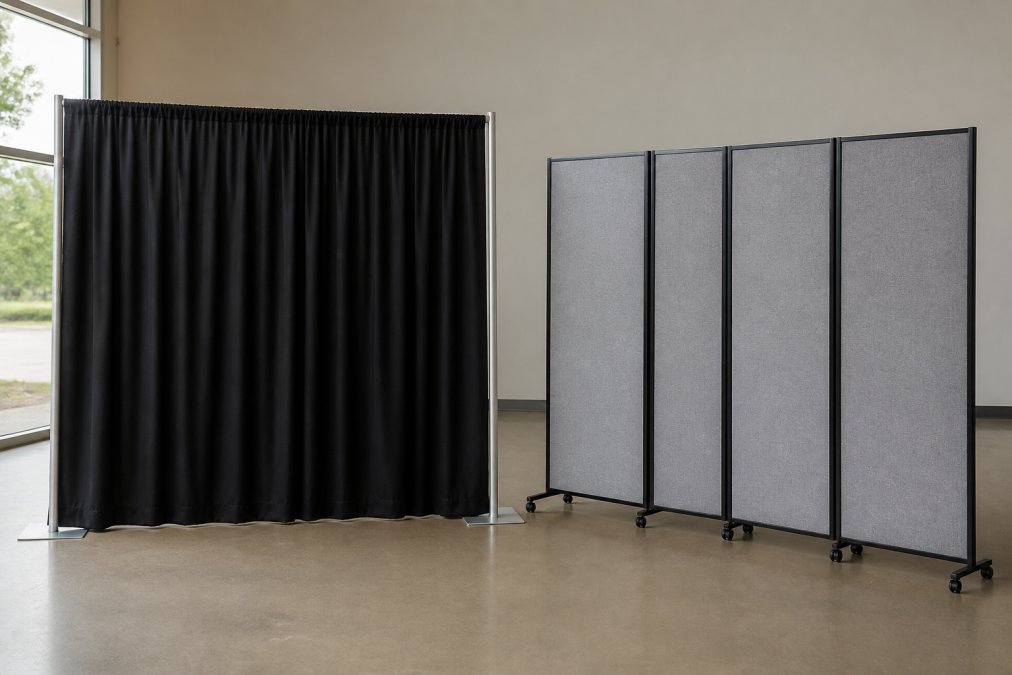
Pipe and drape systems use telescoping uprights, base plates, and crossbars to support fabric panels that can span wide areas. Room dividers, by contrast, are self-contained folding panels that roll into place on casters and lock together with full-length hinges. The core difference is structural: pipe and drape creates a taut fabric wall, while rigid dividers provide a solid, sound-absorbing barrier.
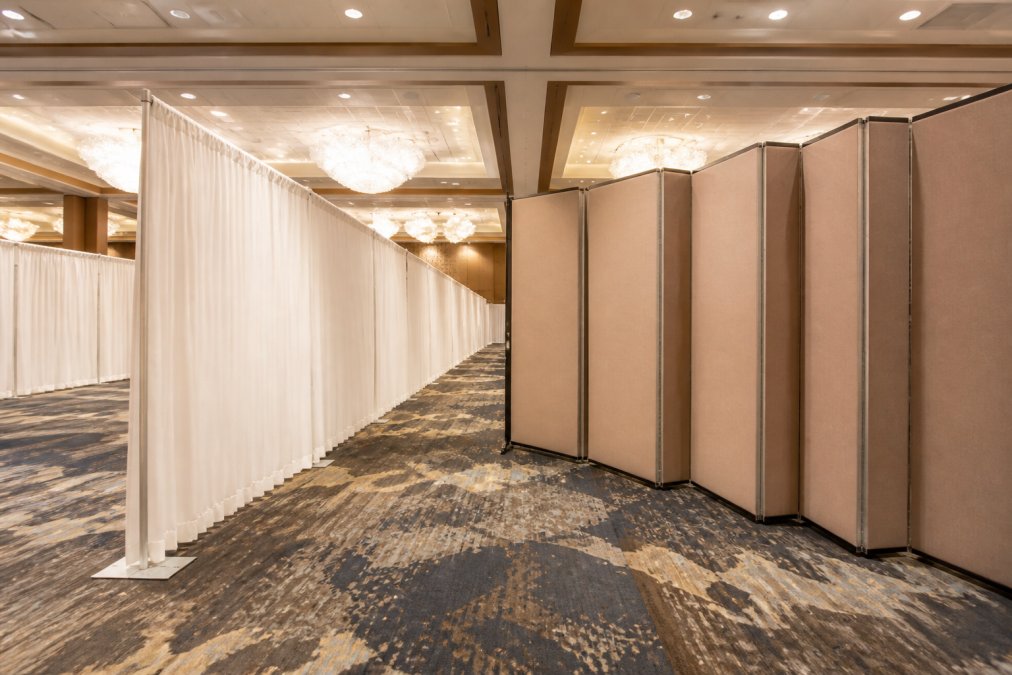
The choice affects storage footprint, transport weight, acoustic performance, and how the space reads visually. Fabric reads as decor; rigid panels read as infrastructure, a distinction that matters when designing a gala versus reconfiguring a conference room.
| Factor | Pipe and Drape | Rigid Room Dividers |
|---|---|---|
| Structure | Fabric over metal frame | Rigid panels on casters |
| Best for | Weddings, galas, trade shows | Classrooms, offices, churches |
| Acoustic performance | Minimal sound dampening | Better sound absorption |
| Storage footprint | Compact, breaks down flat | Bulky, folds but heavy |
| Aesthetic range | Hundreds of colors and fabrics | Limited to panel finishes |
| Setup | Tool-free, minutes per run | Roll into place, lock hinges |
Temporary Wall Solutions for Events: Where Each Option Excels
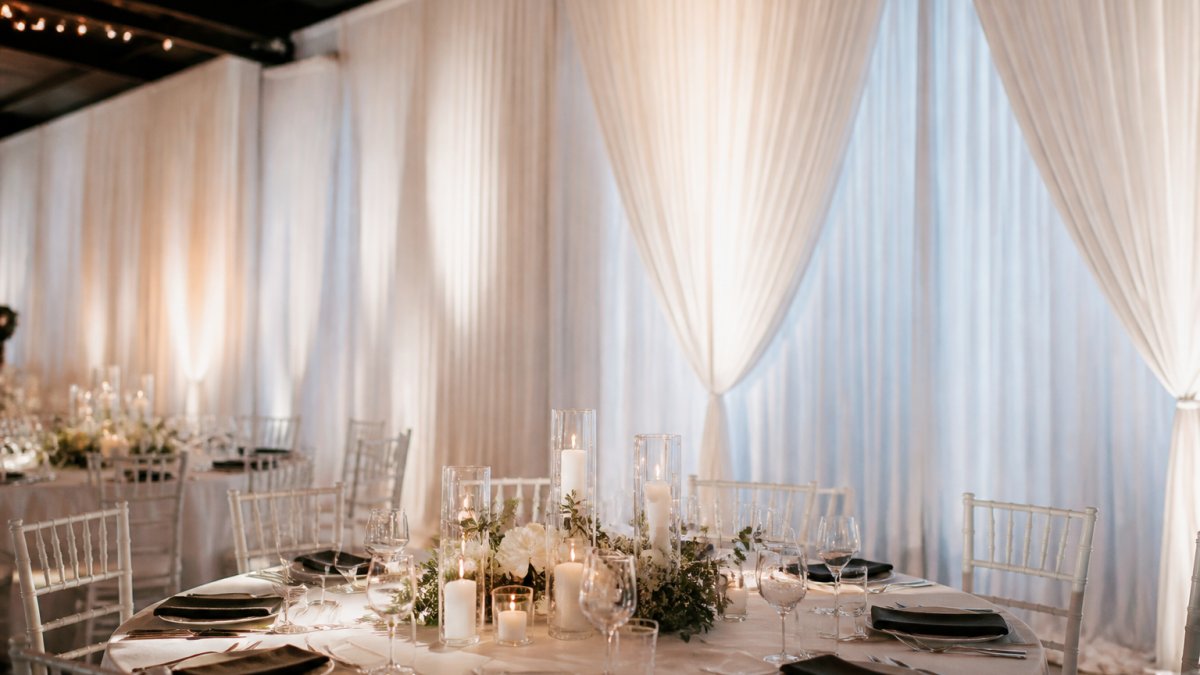
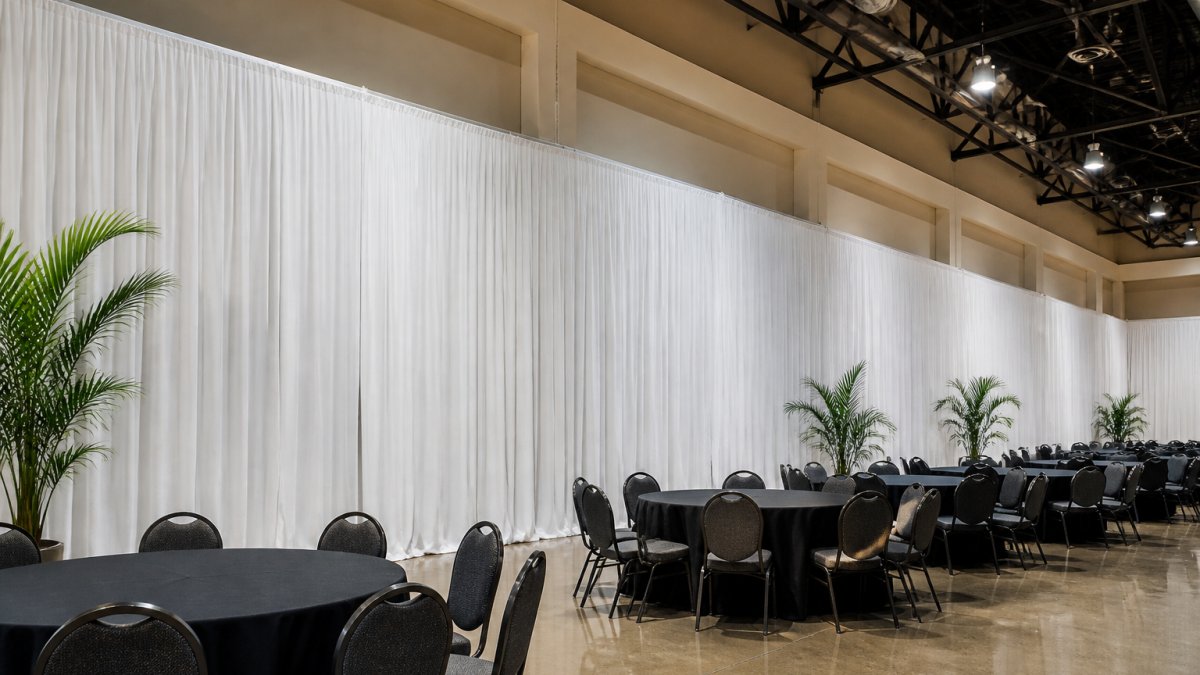
For temporary wall solutions for events, pipe and drape dominates because it scales to venue size and design requirements. A single run can span 50 feet or more, and fabric is easily swapped to match a palette. Rigid dividers work for smaller, repeated divisions but lack the visual flexibility event design demands.
Trade show exhibitors use pipe and drape to define booth boundaries while keeping the space open. Wedding planners use it to hide catering stations or create backdrops. Rigid panels suit venues needing the same weekly configuration, like church classrooms or corporate training rooms, where durability outweighs aesthetics. When the goal is atmosphere, fabric wins.
Pipe and Drape Rental Cost vs. Buying Room Dividers
Pipe and drape rental cost is typically lower upfront than purchasing rigid dividers, especially for one-off events. Buying a commercial-grade accordion wall represents a capital investment that only pays off with frequent, repeated use. Rental pricing for pipe and drape depends on quantity, fabric choice, linear footage, and delivery distance, so quotes vary widely by market and season.
Rigid dividers cost more to transport and store, which is why schools and offices that own them rarely move them far. Event rental companies own commercial-grade pipe and drape hardware because the components are modular and industry-standard. For a single gala or wedding, rent and let the supplier handle delivery, installation, and pickup.
Aesthetic Flexibility and Branding: Fabric vs. Rigid Panels
Fabric delivers branding flexibility rigid panels cannot match. Pipe and drape accepts drapes in a vast range of colors and materials, from sheer organza to heavy velour, allowing precise matching to brand guidelines or a wedding palette. Rigid dividers come in fixed finishes, typically fabric-wrapped or vinyl in limited colors.
For corporate events, a branded drape backdrop with a projected or pinned logo creates a professional focal point. Trade show booths use fabric for a cohesive look across exhibits. Rigid panels work when function matters more than form, but they read as utilitarian. If the divider is visible to guests, fabric better maintains the event's design language.
Stability, Safety, and Acoustics in High-Traffic Areas
Pipe and drape's bad reputation here is only half deserved. The real issue is not the system itself but the base hardware and installation method. Understanding each failure mode tells you which solution fits your venue.
Tipping Risk: Base Plates vs. Weighted Casters
Pipe and drape uprights rely on steel base plates that typically weigh 15 to 25 pounds each. Under normal crowd flow, that is sufficient. The risk profile changes when guests brush against the fabric, when HVAC drafts catch a long unsupported span, or when children run through a ballroom. A common industry rule of thumb is that any run longer than 10 feet between uprights should use crossbars at both top and bottom, and that base plates should be loaded with additional weight (sandbags or steel discs) in high-traffic or outdoor settings (osha.gov).
Rigid accordion dividers are not immune to tipping. Their casters are typically 2 to 3 inches in diameter, and the panels are top-heavy. On carpet they roll poorly; on hard floors they can slide if brakes are not engaged on every caster. Their advantage is a lower center of gravity and continuous footprint, distributing lateral force across the full panel width rather than at discrete uprights.
Fire Code Compliance: What Event Planners Must Verify
Flame-retardant (FR) treatment is not optional. The National Fire Protection Association (NFPA) 701 standard is the benchmark for flame propagation of textiles used in public spaces, and most venue contracts incorporate it by reference (nfpa.org). Municipal fire marshals can and do inspect drapery at large events, and non-compliant fabric can result in fines, event shutdown, or insurance claim denial.
FR certification is not permanent. Fabric that is washed, dry-cleaned, or exposed to humidity can lose its flame-retardant properties. Professional rental companies re-certify on a schedule, but ask for the current certificate for the specific lot being delivered, not a generic statement. If buying fabric for a venue you own, budget for re-treatment every 12 to 18 months depending on wash frequency.
Acoustic Performance: The Numbers Nobody Publishes
Rigid room dividers win on sound control, but the margin is smaller than most assume. A typical fabric-wrapped acoustic panel divider has an STC rating of 20 to 25, reducing transmission by roughly 20 to 25 decibels, enough to make conversation unintelligible but not to block a presentation or loud music (acoustics.org). Pipe and drape offers essentially no measurable sound reduction; the fabric is lightweight and porous, and sound passes freely.
If dividing a ballroom for simultaneous breakout sessions with microphones, neither solution is adequate; you need a portable wall system with an STC rating of 40 or higher, a different product category. For a quiet networking reception next to a louder cocktail area, rigid dividers provide acceptable separation. Pipe and drape only separates sight lines, plan your sound strategy accordingly.
Stability Checklist for High-Traffic Events
Use this checklist when evaluating either system for a crowded venue:
- Pipe and drape: Confirm base plates are steel (not plastic), verify that crossbars are locked at both ends, and add weighted plates to every upright if the event includes dancing or heavy foot traffic near the drape line.
- Rigid dividers: Engage all caster brakes, check that self-leveling feet are adjusted to the floor surface, and avoid configurations longer than three panels without a corner brace.
- Both: Walk the full run after installation and push gently at mid-span. If there is more than an inch of deflection, the system is not stable enough for the crowd size you expect.
Setup Time and Avoiding Wrinkled Drapes for Event Rentals
Setup time for pipe and drape is minutes per section with telescoping uprights and tool-free assembly; two people can erect a 50-foot run in under an hour. Rigid dividers roll into place quickly but require careful hinge alignment and caster leveling, which slows larger configurations.
Avoiding wrinkled drapes starts with the supplier. Professional rental companies steam and inspect fabric before delivery, but wrinkles can still appear during transport. Ask how they handle on-site touch-ups and whether installation includes steaming. DIY setups risk wrinkles if fabric is folded too tightly or hung without proper tension; a taut wall requires the crossbar at the right height and the drape pulled evenly across the span.
How to Decide: A Framework for Event Planners
Most decision frameworks stop at "rent for one-off events, buy for frequent use," missing the real calculation. The deciding factor is not event frequency alone but total cost of ownership (TCO) across storage, labor, replacement, and compliance.
The Total Cost of Ownership Calculation
Consider a business running 20 events per year that rents pipe and drape at $350 per event for a 20-foot run. Annual rental cost: $7,000. Over three years, that is $21,000 with no asset value retained.
Purchasing the equivalent system, 10 uprights, 10 base plates, 5 crossbars, and 100 linear feet of drape fabric, costs roughly $2,500 to $4,000 for commercial-grade hardware and mid-range fabric. But TCO does not stop at the purchase price. Add:
- Storage: A 20-foot run breaks down into components that fit in roughly 16 cubic feet, about the size of a large wardrobe box. If you have that space, cost is negligible. If you are paying for off-site storage, add $50 to $150 per month.
- Labor: Professional installation for a 20-foot run typically runs $150 to $300 per event. If your staff installs it themselves, budget 30 to 45 minutes of labor per event at your internal rate.
- Replacement and maintenance: Base plates get bent, crossbar locks wear out, and fabric gets stained or torn. Budget 5 to 10 percent of the original purchase price annually for parts and fabric replacement.
- Compliance: If you own the fabric, you own the FR re-certification obligation. Professional re-treatment and certification runs $100 to $300 per year depending on fabric volume.
At 20 events per year, the breakeven point lands between 12 and 18 months. At 5 events per year, renting remains cheaper indefinitely.
The Decision Matrix
Work through these five questions in order:
- How many events per year? Fewer than 12: rent. More than 12: run the TCO calculation above.
- Is sound separation a requirement? If yes, pipe and drape is disqualified regardless of budget. Move to rigid dividers or portable walls.
- Does the venue change between events? If you use the same room weekly, rigid dividers that stay in place make sense. If the layout changes every time, the storage and transport weight of rigid panels becomes a liability.
- Who installs it? If you have in-house staff with no event production experience, pipe and drape's tool-free assembly is the safer choice. Rigid dividers require more care in alignment and leveling.
- What does the space need to look like? If the divider is visible to guests and part of the design language, fabric wins. If it is behind the scenes, separating storage, hiding utility areas, rigid panels are fine.
The Hybrid Approach Most Planners Overlook
A common pattern among experienced producers is owning a small pipe and drape kit for back-of-house use (registration tables, catering staging, storage concealment) while renting decorative drapes for guest-facing spaces. This hybrid captures ownership's TCO benefits for utilitarian applications while avoiding the capital cost of maintaining a large inventory of aesthetic fabrics that go out of style.
For venues with ceiling heights above 14 feet, confirm the drape system's maximum height before committing. Standard telescoping uprights top out around 12 to 14 feet; taller installations require truss systems or ceiling-mounted track, a different product category with different labor requirements.
Event Drape Rental supplies professional-grade pipe and drape with drapes ranging from 12 to 30 feet in height, over 100+ colors, and 6 fabric materials, with both DIY and professional installation options. For a quote tailored to your venue layout and timeline, request pricing through the website.
Frequently Asked Questions
What is the cheapest way to partition a room for an event?
For most events, renting pipe and drape is the most cost-effective way to partition a large space. Rental costs are typically lower than purchasing rigid room dividers, especially for one-time or occasional events. Pipe and drape also requires less storage space and can be configured in various widths and heights. For permanent or daily reconfiguration needs, buying accordion-style dividers may offer better long-term value despite the higher upfront investment.
How much does professional pipe and drape rental cost?
Professional pipe and drape rental costs vary based on the total linear footage, drape height, fabric selection, and whether you need delivery and installation. A standard 10-foot tall setup with basic fabric will cost less than a 30-foot tall drape with premium material. Request a quote from Event Drape Rental for exact pricing. Their team can provide a custom cost estimate based on your venue layout and event dates.
Are pipe and drape systems more versatile than portable walls?
Yes, pipe and drape systems offer greater versatility for event applications. The modular design allows you to create curved lines, full room divisions, backdrops, or booth partitions using the same components. Fabric panels come in over 100+ colors and multiple materials, making it easy to match brand guidelines or wedding themes. Portable accordion walls are limited to straight configurations and offer fewer aesthetic options.
How do you prevent wrinkles in rental drapes before an event?
Professional rental companies like Event Drape Rental steam and inspect drapes before delivery, which minimizes wrinkles. If drapes arrive with creases from transport, hang them immediately and use a handheld steamer on low heat. Avoid folding drapes tightly for storage. For large installations, schedule delivery a few hours before setup so fabric has time to relax and any minor wrinkles can fall out naturally.
Choosing between pipe and drape and room dividers is ultimately a question of event goals. Rigid dividers serve functional, repeated divisions, but fabric systems create the atmosphere and branding that define memorable events. Event Drape Rental provides the inventory and installation flexibility to handle venues from ballrooms to 40-foot warehouses, with flame-retardant fabrics and professional-grade hardware. Request a quote and get the drape solution that fits your next event.
This article was written using GrandRanker