 comparison
Is Renting White Drapes for a Wedding Reception Worth It?
Table of Contents
- The Real Question: Do White Drapes Earn Their Place in Your Reception Budget?
- What Wedding Draping Rental Cost Actually Covers (And What It Doesn't)
- Ceiling Drapes for Wedding Reception Spaces: The Highest-Impact Placement
- DIY Wedding Draping: When It Saves Money and When It Costs You
- Pipe and Drape Wedding Rental: What the Hardware Actually Delivers
- White Fabric Selection: Why Not All White Drapes Look Alike
- A Decision Framework: When White Drapes Are Worth the Rental Fee
- Frequently Asked Questions
Last Updated: October 21, 2026
The Real Question: Do White Drapes Earn Their Place in Your Reception Budget?
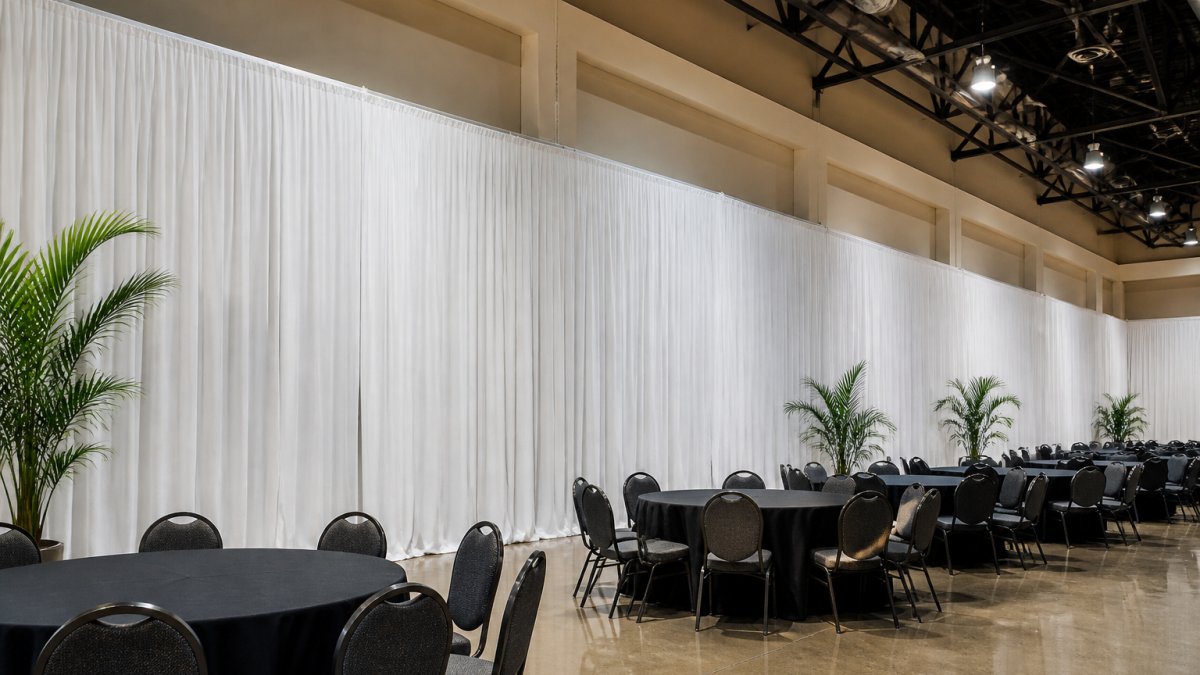
White drapes are temporary fabric installations, usually rented, that cover a venue's walls, ceiling, or backdrop to change how a space looks and photographs. The question of whether renting white drapes for a wedding reception is worth it comes down to one thing: how much of your venue's existing appearance you need to hide or improve.
That answer changes dramatically from venue to venue. A tent with visible metal framing and a rented hall with dated wallpaper are two very different problems.
Below, we break down what a draping quote actually contains, where the money goes, and when the rental fee is easy to justify. We also cover when it isn't, because a straight answer serves you better than a sales pitch.
What Wedding Draping Rental Cost Actually Covers (And What It Doesn't)
Wedding draping rental cost is driven by four things: fabric quantity, hardware, labor, and logistics. Most quotes bundle them into one number, which is exactly why couples struggle to compare bids. A published guide from CV Linens' wedding draping cost breakdown frames basic wedding draping in the low hundreds to around a thousand dollars, with more extensive installations climbing well past that.
Line Items You'll See on a Draping Quote
- Fabric rental, priced per panel or per linear foot, based on coverage
- Hardware, uprights, crossbars, bases, and any ceiling rigging
- Delivery, often charged by distance and time window
- Installation labor, crew size multiplied by hours on site
- Strike and pickup, removing everything after the event, frequently a separate line
How the Quote Scales With Setup Size
A draping quote is not a single rate. It scales with three variables, and understanding them lets you sanity-check any bid.
- Linear feet of coverage. Wall and backdrop draping is usually priced per linear foot of finished run. A 40-foot wall costs roughly four times a 10-foot backdrop in fabric and hardware, before labor.
- Ceiling height. Overhead work above roughly 12 feet typically requires a lift rather than ladders, and lift rental plus a trained operator is a separate cost tier. A ballroom with a 24-foot ceiling is not priced like a tent with a 10-foot peak.
- Crew hours on site. Installation labor is crew size times hours. A two-person crew for three hours is a different line than a four-person crew for six hours, and venue access windows often force the larger crew.
A common pattern is that the fabric itself is the smallest share of a full-service quote. Delivery, labor, and strike usually outweigh the fabric line once installation is included. That is why a quote that looks high on fabric but low on labor deserves a second look, and vice versa.
Rent vs. Buy: A Side-by-Side Look at White Fabric
Buying fabric sounds cheaper until you account for everything rental includes.
| Factor | Renting White Drapes | Buying White Fabric |
|---|---|---|
| Upfront cost | Rental fee plus delivery and labor | Fabric cost plus hardware purchase |
| Fabric quality | Professional-grade, often flame-retardant | Varies widely by source |
| Wrinkles and pressing | Handled before delivery | Your responsibility |
| Hardware | Included | Purchased or improvised |
| Setup and strike | Available as a service | Entirely on you |
| Storage after the event | None | Yours to store indefinitely |
| Resale value | Not applicable | Low and slow to sell |
Renting wins on labor, logistics, and finish. Buying only makes sense if you plan to reuse the fabric across multiple events or repurpose it afterward. Run the buy math honestly: add fabric, hardware, a steamer or pressing service, transport, and your own time, then subtract what you could realistically resell the fabric for.
Questions to Ask Before You Sign
- Is installation and strike included, or quoted separately?
- Is there a minimum order or minimum crew charge?
- What is the damage deposit, and what counts as damage versus normal wear?
- What are the cancellation and reschedule terms?
- Who confirms the measurements, you or the provider?
Getting these answered in writing is the difference between a quote you can compare and one you cannot.
Ceiling Drapes for Wedding Reception Spaces: The Highest-Impact Placement
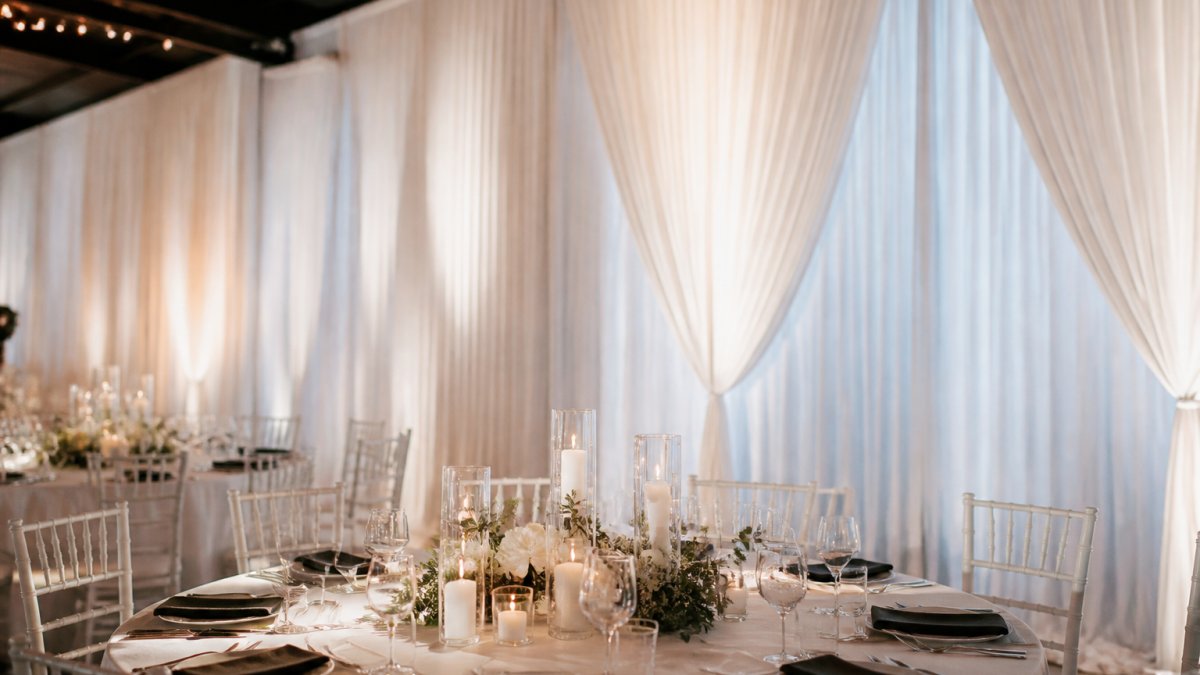
Ceiling drapes for a wedding reception change the entire character of a room more than any other single treatment.
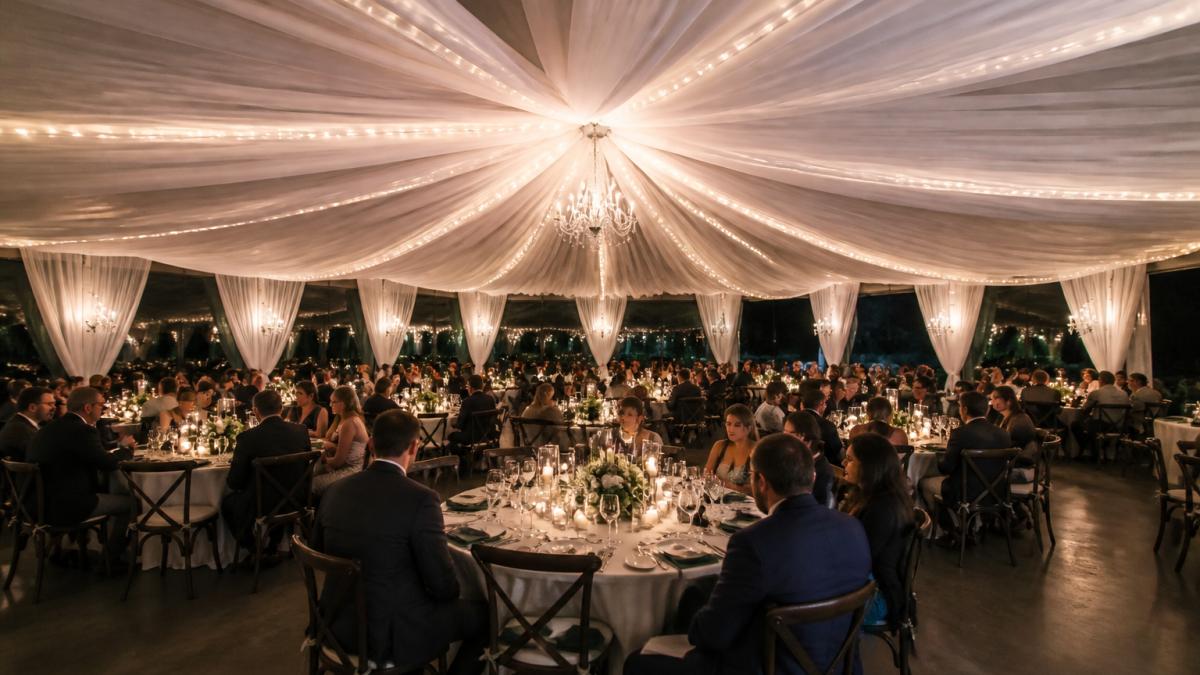
The tradeoff is cost and complexity. Ceiling work requires rigging points, adequate ceiling height, and crews trained to work overhead safely.
DIY Wedding Draping: When It Saves Money and When It Costs You
DIY wedding draping saves money on labor and loses it on time, equipment, and risk. The break-even point depends almost entirely on ceiling height and room size.
For a low backdrop behind a ceremony arch or a simple wall panel, a motivated couple with a helper can handle installation in an afternoon. For anything involving overhead rigging, 12-foot-plus heights, or full-room coverage, the math flips fast.
Pipe and Drape Wedding Rental: What the Hardware Actually Delivers
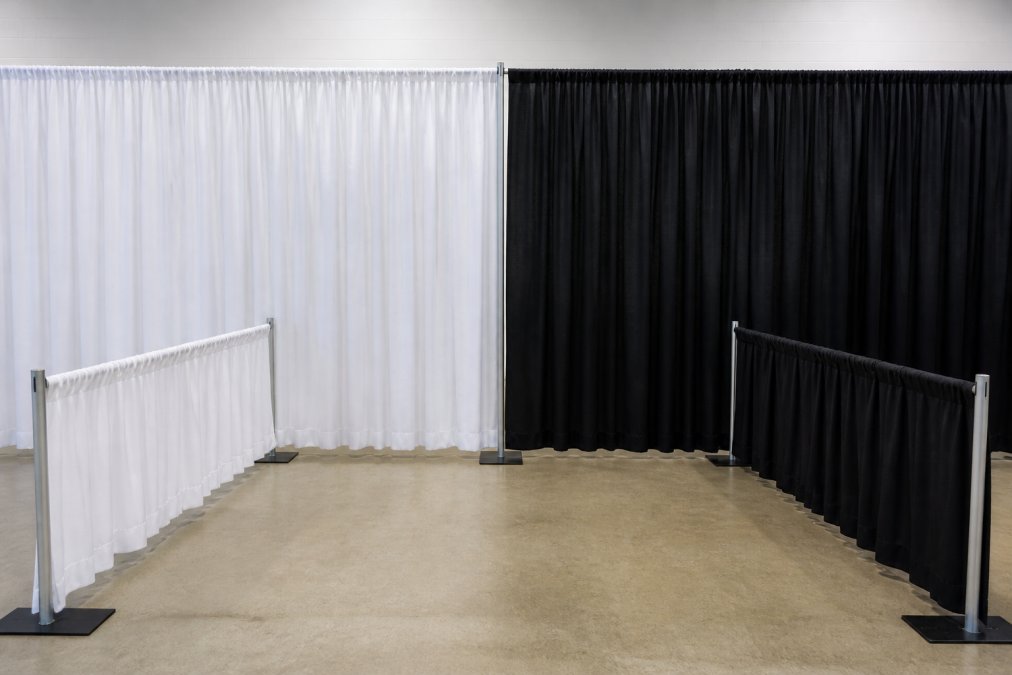
Pipe and drape wedding rental is the workhorse system behind most freestanding drape installations.
That freestanding design matters more than couples realize. Many venues prohibit attaching anything to walls, ceilings, or fixtures.
Hardware quality shows up in the details. Sturdy bases resist tipping in high-traffic areas, and adjustable uprights let one system handle a range of heights. Ask what heights your rental provider stocks.
White Fabric Selection: Why Not All White Drapes Look Alike
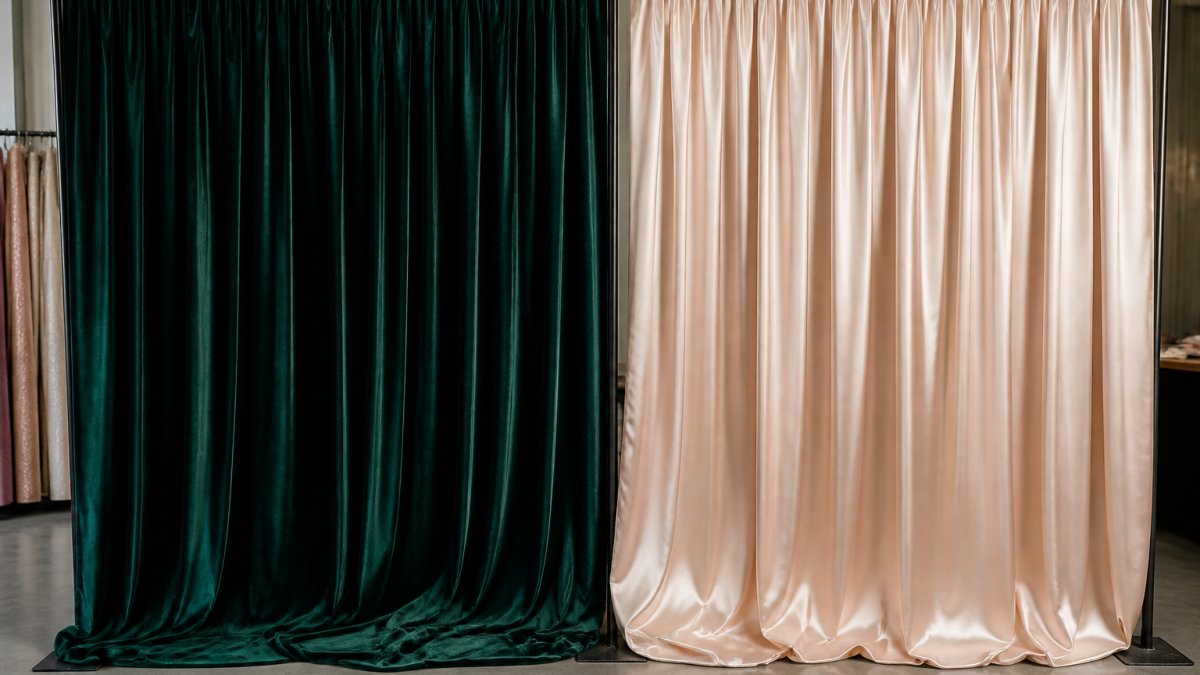
White is not one color under event lighting. A fabric comparison guide from Liba Fabrics walks through voile, chiffon, satin, velvet, and flame-retardant poplin, and the differences matter for how a room photographs.
Most draping guides stop at naming fabrics. The useful comparison is how each one behaves in a real venue, because the same white fabric can look warm, cool, flat, or glowing depending on what is lighting it.
How the Common White Fabrics Compare
- Voile. The lightest and most transparent option. It lets daylight and uplighting pass through, softens hard edges, and reads airy rather than solid. It wrinkles easily and needs steaming before delivery. Best for ceremony spaces with windows and any setting where you want light rather than coverage.
- Chiffon. Slightly more body than voile, with a soft drape and a gentle sheen. It photographs romantic and works well for swags and ceiling treatments where you want movement. It shows creases if packed poorly, so confirm the provider steams it.
- Organza. Crisp and structured with a subtle sheen. It holds shape better than voile or chiffon and suits backdrops that need to look tailored rather than billowy. Less forgiving of wrinkles than chiffon.
- Satin. Opaque with a high sheen. It blocks light and creates a formal, solid backdrop, but the sheen can catch camera flash and read glossy in photos. Best used where you want structure, not softness.
- Velvet. The heaviest and most opaque. It absorbs light, reads rich and warm, and creates a dramatic, enclosed feel. It is also the most expensive to rent and the hardest to keep lint-free.
Color Temperature and Lighting
White fabric takes on the color of whatever lights it. Warm uplighting pushes white toward cream or champagne; cool LED wash pushes it toward blue-gray. Sheer fabrics amplify this because light passes through them, while opaque fabrics reflect it. If your venue uses warm string lights or amber uplights, a sheer white will read warmer than the swatch you approved.
Wrinkles, Sheen, and Photography
Wrinkle behavior matters more than couples expect. Sheer fabrics crease in transit and need steaming; opaque fabrics hide creases better but show sheen. Under camera flash, satin and other high-sheen fabrics can produce glare that flattens the drape in photos, while matte poplin and velvet photograph more evenly. If photography is a priority, favor matte finishes and confirm the provider steams before delivery.
What to Confirm With Your Provider
- Is the fabric flame-retardant, and can they provide certification if the venue requires it?
- Is it steamed before delivery, or is pressing a separate charge?
- Can you see a swatch under warm and cool light?
- What is the fabric's width and how does that affect panel count and seams?
- How does the fabric behave outdoors if any part of the setup is in a tent?
A Decision Framework: When White Drapes Are Worth the Rental Fee
White drapes are worth renting when the venue's raw appearance would otherwise dominate your photos and your memory of the day. Use this framework to decide.
- The room has visible flaws you cannot decorate around: exposed ceiling, damaged walls, mismatched finishes
- Ceiling height exceeds what you can safely reach without professional equipment
- The venue restricts wall or ceiling attachments
- Photography is a priority and the existing backdrop is busy or dated
- Your access window is short and setup time is limited
- The room is large enough that draping changes the perceived scale
If you checked three or more, rental is likely the better call.
We stock over 100 colors and multiple fabric types, with drapes from 12 to 30 feet and both DIY and professional installation options.
Frequently Asked Questions
How much do ceiling drapes cost for a wedding?
Ceiling drapes are typically the most expensive draping element because they require more fabric, higher rigging, and more labor. Published wedding cost guides put basic draping around $300 to $1,000, with extensive installations running $1,000 to over $5,000. Ceiling work sits at the higher end because of height and safety requirements. For an accurate figure, request a quote with your venue's ceiling height and square footage.
Is it cheaper to make your own curtains or buy them?
Making your own curtains can be cheaper on fabric alone, but the savings shrink once you add rental hardware, sewing time, and the risk of uneven panels. Buying or renting ready-made white drapes usually wins on consistency and fire-retardant compliance. If your venue requires flame-retardant certification, homemade fabric often fails that check. Compare the full cost, including your hours, before deciding.
Can I install wedding drapes myself?
Yes, DIY wedding draping is possible for backdrops, room dividers, and lower ceiling treatments using pipe and drape kits. It becomes risky above 12 feet, where ladders, rigging points, and venue safety rules come into play. Many venues require proof of insurance or a professional installer for overhead work. Ask your venue what they allow before you plan a DIY setup.
What should I ask a draping rental company before booking?
Ask about fabric condition, flame-retardant certification, delivery and setup fees, and whether the quote includes labor. Confirm the maximum drape height they can supply and how they handle wrinkles or damage on arrival. Also ask about contract terms for venue load-in times and same-day multi-location delivery. A written itemized quote protects you from surprise charges.
Are white drapes worth the rental cost?
White drapes are worth it when your venue has flaws to hide, high ceilings to soften, or a plain backdrop that photographs poorly. They deliver the most visual impact per dollar in large, unadorned spaces. In a venue that is already elegant, the return is lower. Use your venue's existing features and photo needs to decide whether white drapes earn a line in your budget.
The hardest part of this decision is not the fabric or the hardware. It is knowing whether your specific room needs the treatment at all. Send us your venue details, ceiling height, and event date, and we will help you scope the coverage honestly. Request a quote from Event Drape Rental and get a clear, itemized proposal built around your space rather than a generic package.