 ultimate-guide
Renting Drapes for Large Trade Shows: A Complete Guide
Table of Contents
- Why Renting Drapes for Large Trade Shows Beats Buying
- Trade Show Booth Drapery Requirements: What You Need to Know
- How to Calculate Linear Footage for Your Exhibit Space
- Fire Retardant Drape Rental: Compliance and Safety Standards
- Pipe and Drape Installation Services: DIY vs. Professional Setup
- Color Selection and Custom Sizing for Brand Impact
- Logistics: Delivery Timelines and On-Site Assembly
- Conclusion: Plan Your Rental Early for a Seamless Expo
- Frequently Asked Questions
Last Updated: September 4, 2026
Why Renting Drapes for Large Trade Shows Beats Buying
Pipe and drape rental for large trade shows solves the three problems that plague in-house inventory: storage, maintenance, and scalability. A single 10x10 booth requires roughly 30 linear feet of draping, and a 20x20 island exhibit can need triple that amount.
Renting eliminates those headaches entirely: you specify dimensions and fabric, and the material arrives pressed, fire-retardant, and ready to hang. When the show ends, the rental company handles tear-down and transport.
Renting is standard for exhibitors who treat their booth budget as a marketing expense rather than a capital purchase, keeping brand presence fresh without writing off depreciating assets.
Trade Show Booth Drapery Requirements: What You Need to Know
Trade show booth drapery requirements start with the venue's rules, not your aesthetic preferences. Most convention centers mandate fire codes, covered below. Beyond safety, requirements break down into height, configuration, and fabric weight.
Standard Heights and Booth Configurations
Standard pipe and drape heights are 8 feet for inline booths and 10 feet for most island exhibits, aligning with typical ceiling heights and sightline regulations. Panels attach to uprights, vertical poles secured by base plates, with crossbars spanning the top. Uprights are placed at 8- to 10-foot intervals depending on your space's linear footage.
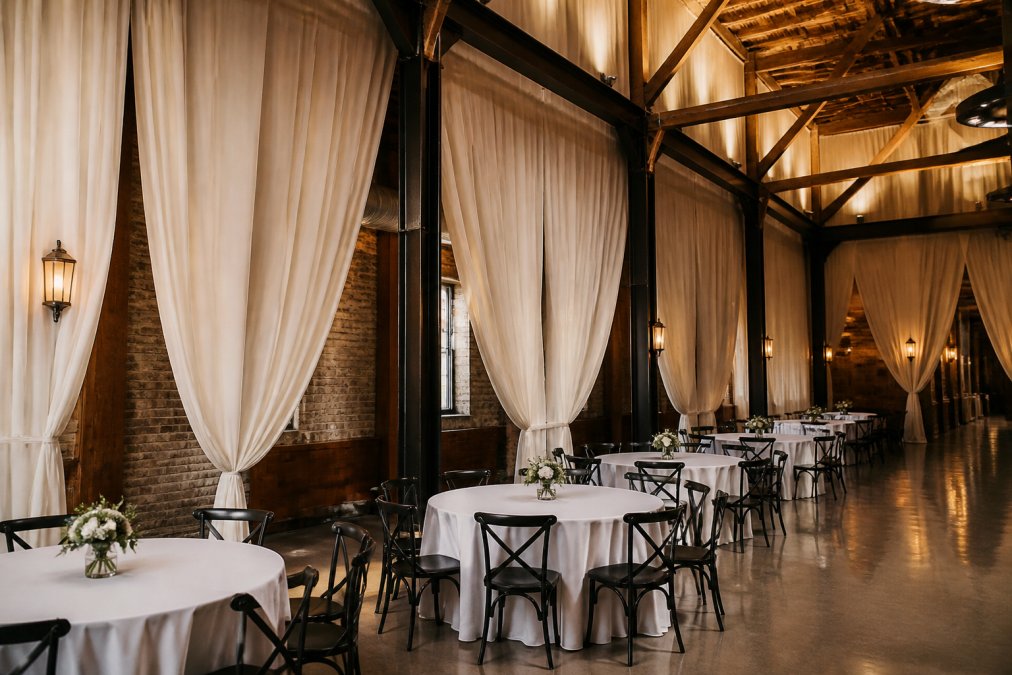
Custom sizing becomes necessary for unusual dimensions or tall ceilings. For warehouse-style venues with exposed trusses, drapes from 12 to 30 feet create dramatic backdrops and divide large spaces.
Fabric Types: Velour, Sheer, and Blackout Options
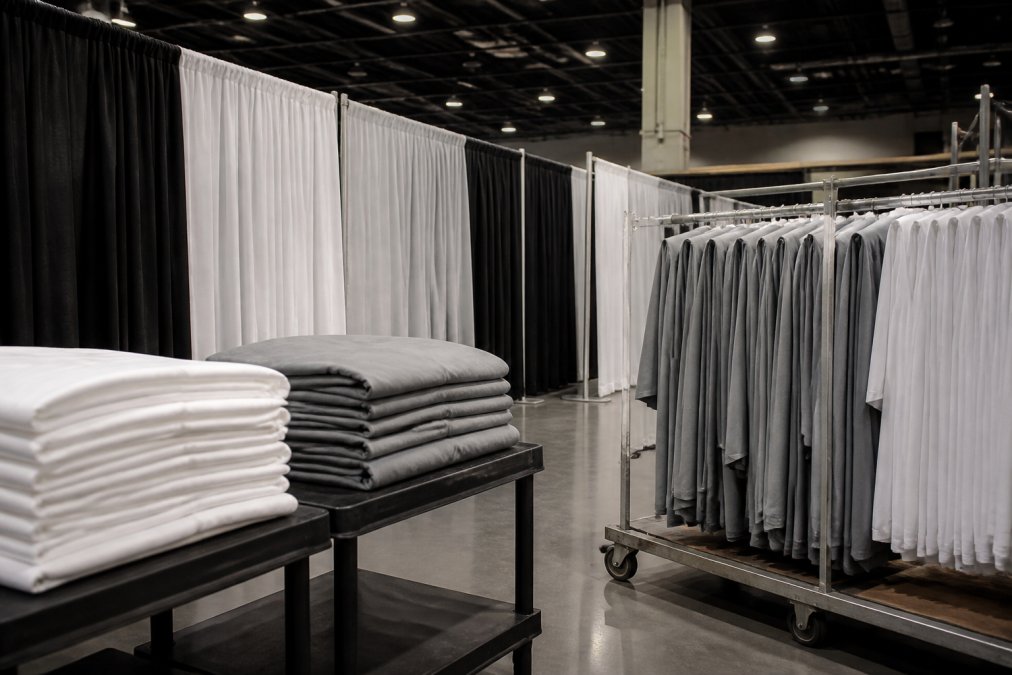
The fabric you choose determines both the look and the function of your booth dividers. Velour is the workhorse of the industry: heavy, wrinkle-resistant, and available in a deep matte finish that photographs well under harsh exhibition lighting. It provides a premium backdrop for product displays and brand messaging.
Sheer fabrics diffuse light and create an airy, open feel. They work well for aisle-front treatments or when you want visibility into your booth from the concourse. Blackout fabric blocks light completely, making it the right choice for presentation areas, video viewing spaces, or when you need to control the visual environment inside your booth.
Panel width and fabric weight affect how material hangs: heavier fabrics like velour drape in clean folds, while lighter fabrics may need weighting at the hem to prevent HVAC airflow movement.
How to Calculate Linear Footage for Your Exhibit Space
Linear footage is the industry standard for quoting pipe and drape. The basic formula is simple: measure the perimeter requiring draping and divide by upright spacing. But most exhibitors underestimate needs by overlooking key variables.
Step 1: Map Your Exposed Sides
Sketch your booth footprint and mark which sides are open to the aisle. A standard 10x10 inline booth has three exposed sides, the back wall typically backs up to another booth or divider. A corner booth exposes two full sides and one half-side. An island booth is open on all four sides.
Step 2: Account for Upright Spacing, Not Just Perimeter
Drape panels are manufactured in fixed widths, typically 8 feet, so your linear footage must be rounded up to the nearest panel width. A 10x10 booth with three exposed sides has a 30-foot perimeter, but with 8-foot panels you need four panels (32 linear feet). Always round up and confirm your provider's panel width.
Step 3: Add for Overlap and Returns
Professional installations overlap panels by 2 to 4 inches at each upright to prevent light gaps. On a 50-foot run, that adds roughly 1 to 2 linear feet. You also need return panels, short sections wrapping wall ends or corners, often quoted separately, so ask whether they are included in the per-linear-foot price.
Quick Reference for Common Booth Sizes
The table below reflects the industry-standard calculation for typical booth configurations, assuming 8-foot panel widths and three exposed sides for inline booths. For island booths, the full perimeter is used.
| Booth Size | Configuration | Exposed Sides | Base Perimeter | Rounded Linear Feet (with overlap) |
|---|---|---|---|---|
| 10x10 | Inline | 3 | 30 ft | ~32 linear feet |
| 10x20 | Inline | 3 | 50 ft | ~56 linear feet |
| 20x20 | Island | 4 | 80 ft | ~88 linear feet |
| 20x30 | Island | 4 | 100 ft | ~108 linear feet |
The Hidden Variable: Venue-Provided Drapes
Before calculating anything, check your exhibitor services manual. Many convention centers include a basic 8-foot gray or white backdrop for inline booths as part of the space rental. If you accept it, you only need to rent drapes for the side and front walls. If you want a branded color or taller backdrop, decline the venue's drape in writing before the advance-order deadline.
The 10 Percent Buffer Rule
Most experienced exhibit managers add a 10 percent buffer to cover measurement errors, layout changes, and last-minute additions like a demo counter needing a draped skirt. On a 100-foot order this adds modest cost but prevents an emergency mid-setup order at premium rates.
Once you have your linear footage calculated, the next step is confirming that your fabric meets the fire safety standards enforced at the venue, a topic covered in the compliance section below.
Fire Retardant Drape Rental: Compliance and Safety Standards
Fire retardant drape rental is not optional. Venues enforce fire safety codes requiring all decorative materials to be flame-resistant or treated with an approved fire retardant. The authority having jurisdiction, typically the local fire marshal, can inspect booths during setup and require proof of compliance.
The standard that governs this testing is NFPA 701, published by the National Fire Protection Association, which specifies methods for assessing the flame propagation of textiles and films. Reputable rental companies maintain inventory that meets these standards and can provide documentation upon request. When you rent drapes for large trade shows, ask the provider whether the fabric is inherently fire-retardant or treated, and request a certificate of compliance to keep with your show paperwork.
The compliance burden is one of the strongest arguments for renting: commercial rental inventory is tested and certified as part of the rental cycle, whereas discount-supplier fabric may arrive without documentation.
Pipe and Drape Installation Services: DIY vs. Professional Setup
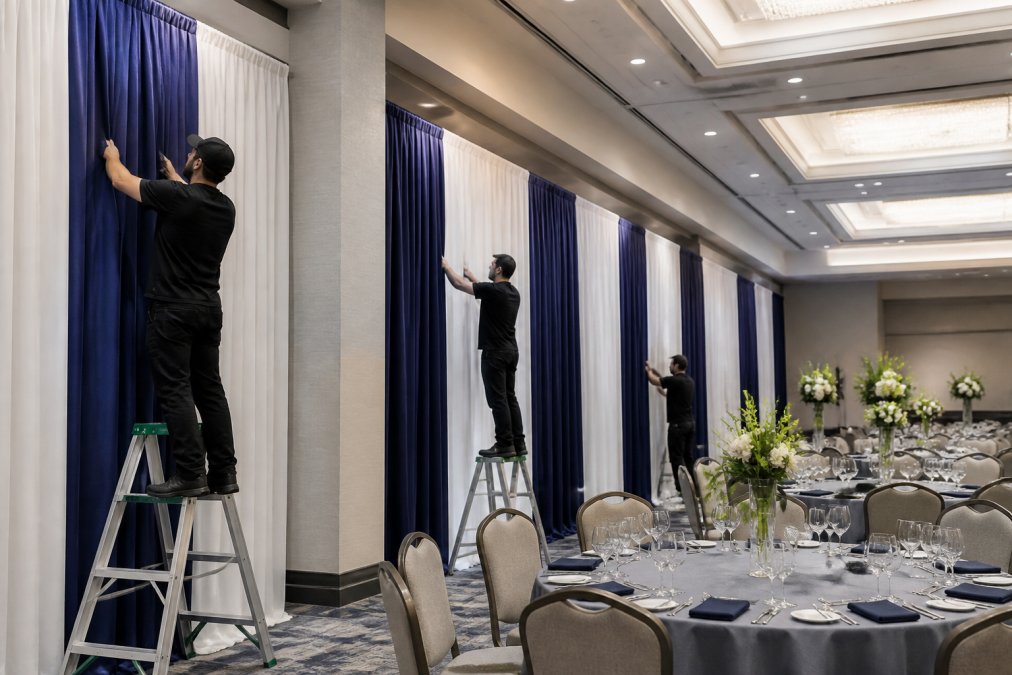
Pipe and drape installation services range from drop-shipped equipment you assemble yourself to full-service teams handling delivery, setup, and strike. The right choice depends on your booth size, on-site labor, and configuration complexity.
For a single 10x10 booth, DIY installation is manageable, setup takes two people about 30 to 45 minutes. For larger configurations, including island booths with custom sizing or multi-level backdrops, professional installation becomes practical. An experienced crew can assemble a 20x20 island in under two hours, while an untrained team might spend half a day and still produce sagging lines.
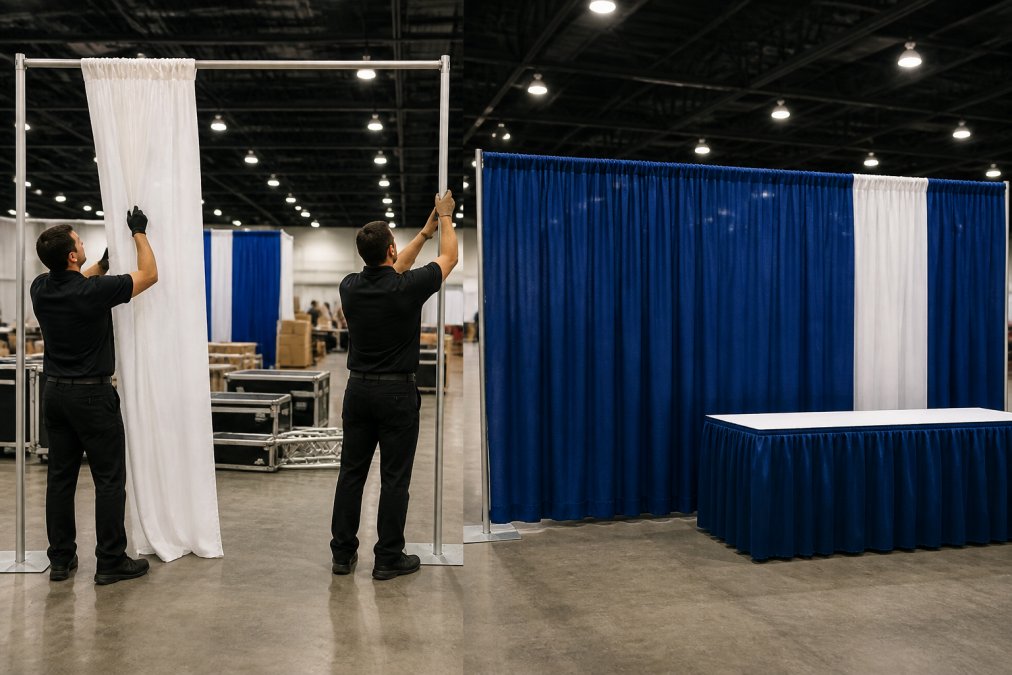
Event Drape Rental offers both approaches: DIY kits with clear instructions, or professional installation where our crew manages on-site assembly. DIY saves labor cost but consumes your team's time; professional installation adds cost but removes the risk of a sloppy presentation.
Color Selection and Custom Sizing for Brand Impact
Color consistency is where rented drapes either elevate or undermine your brand presence. Mismatched or off-brand drapery signals disorganization before a single conversation happens.
Event Drape Rental maintains over 100 colors across multiple fabric types, so your dividers, backdrops, and accent drapes can align with your approved brand palette.
Custom sizing follows the same logic. Standard 8-foot drapes work for most inline booths, but a 40-foot-tall converted warehouse or atrium venue requires a different approach. Drapes from 12 to 30 feet open up venue options standard inventories cannot serve. Confirm ceiling height at the actual drape points, then verify your provider can supply panels that reach the full distance without gaps.
Logistics: Delivery Timelines and On-Site Assembly
The logistics of renting drapes follow a compressed, deadline-driven timeline. Most providers require one to two weeks' lead time to confirm inventory, prepare fabric, and schedule delivery. During peak season, September through November and February through April, that extends to three or four weeks. Booking as soon as your booth space is confirmed locks in your preferred fabric and color.
The Setup Window: Understanding Your Show Schedule
Every trade show operates on a published move-in schedule. The general contractor assigns each exhibitor a setup window, typically 4 to 8 hours depending on booth size, and your drape rental must arrive and be installed within it. Early arrivals are held by receiving, often at $50 to $150 per day, while late arrivals leave your crew idle.
The 72-Hour Rule for Advance Shipping
Most convention centers require advance shipments to arrive no earlier than 72 hours before the first day of move-in; earlier shipments are refused or incur penalties. Your provider should coordinate delivery with the venue's receiving schedule.
On-Site Assembly Timeframes by Booth Size
Setup time varies significantly by booth size and configuration. The following estimates reflect typical crew sizes and assume a clean, level concrete floor with no unusual obstacles:
| Booth Size | Crew Size | Setup Time | Teardown Time |
|---|---|---|---|
| 10x10 inline | 2 people | 30-45 minutes | 20-30 minutes |
| 10x20 inline | 2 people | 1-1.5 hours | 45 minutes |
| 20x20 island | 3-4 people | 2-3 hours | 1.5 hours |
| 20x30 island with custom heights | 4-6 people | 3-4 hours | 2 hours |
These timeframes assume drapes arrive pre-pressed and hardware is organized by section. If your provider ships drapes on a single rack without labeling panels by section, setup time can double as your crew sorts through material.
Union Labor Rules and Venue Access
Large convention centers in major markets operate under union labor agreements. In some venues, installation of pipe and drape above a certain height, typically 10 feet, must be performed by union carpenters or riggers (osha.gov). This is a venue rule you cannot avoid. Ask about it before you book, because an unexpected union requirement can add several hundred dollars to your installation cost.
The Strike Window: Teardown and Pickup
Teardown, or strike, happens during the show's published move-out period. Most venues require all exhibitor materials removed within 4 to 6 hours after the floor closes. Confirm your provider's crew has floor access during move-out, some venues restrict access during the first hour after close for security. A provider that has worked the venue before will schedule accordingly and avoid late-teardown penalties of $100 to $500 per hour.
What to Confirm Before You Sign the Rental Agreement
The following checklist covers logistics details that separate a smooth rental experience from a show-floor disaster:
- Delivery date and time window, Confirm the provider will deliver during your setup window, not just on the same day.
- Venue receiving address, The provider must ship to the venue's advance warehouse or direct-to-floor address, not your office.
- Storage fees, Clarify who pays if the venue holds the shipment early.
- Union labor requirements, Confirm the provider knows the venue's jurisdictional rules and includes compliant labor in the quote.
- Teardown window, Verify the crew will be on-site during move-out, not the following morning.
- Emergency contact, Get a phone number for the provider's on-call person who can respond during setup hours if panels are missing or damaged.
The International Association of Exhibitions and Events publishes best-practice guidance on exhibit logistics that underscores the value of working with vendors who understand convention center workflows. A provider with experience in expo environments knows how to navigate freight elevators, union labor rules, and venue access windows, and that knowledge is what keeps your booth on schedule.
Planning your logistics timeline early, ideally 4 to 6 weeks before the show, gives you room to resolve union questions, confirm delivery windows, and avoid premium last-minute rates.
Conclusion: Plan Your Rental Early for a Seamless Expo
Renting drapes for large trade shows comes down to a simple principle: the decisions you make before the show determine how professional your booth looks on the floor. Calculating linear footage accurately, confirming fire compliance documentation, and booking early prevent the most common exhibitor headaches.
For exhibitors who need a partner with the inventory depth and height range to handle complex spaces, Event Drape Rental provides drapes from 12 to 30 feet tall, over 100 color options, and six fabric materials, with both DIY and professional installation available. Request a quote with your booth dimensions and let the team handle the rest.
Frequently Asked Questions
How much does it cost to rent drapes for a trade show?
Rental pricing for pipe and drape varies based on the total linear footage, fabric type, installation method, and your event dates. For a large exhibit booth, the investment is usually far less than purchasing and storing drapery you'll only use a few times per year. Request a quote with your booth dimensions and color needs to get an accurate figure for your specific setup.
What are the standard height requirements for trade show pipe and drape?
The most common trade show drapery height is 8 feet, which works for most inline booths with 10-foot ceilings. If you're in an island booth or a venue with higher ceilings, you may need 10-foot or 12-foot drapes to maintain visual impact. Always confirm the maximum allowable height with the show organizer before ordering, as some venues have strict sightline rules that prohibit taller backdrops.
Do trade show drapes need to be fire retardant?
Yes. Most convention centers and expo halls in the United States require all drapes and fabrics to meet NFPA 701 fire safety standards. When you rent from a professional company, the drape inventory should already be certified and labeled as flame-retardant. Ask your rental provider for documentation of compliance before your event, and keep that paperwork available on-site in case venue staff request to see it.
How do I determine the amount of drapery needed for a large booth space?
Measure the perimeter you want to cover. For a standard 10x10 booth, you'll need about 30 linear feet to wrap three sides. For a 20x20 island booth, you'll need roughly 80 linear feet plus additional material for any columns or dividers. A reliable rental company will help you calculate exact footage based on your booth configuration and drape height, so share your floor plan when requesting a quote.
The challenge of a large trade show is that every detail reflects on your brand, and drapery is one of the most visible elements of your space. Event Drape Rental removes the logistics burden with professional-grade, fire-retardant fabric, flexible installation options, and an inventory built for custom configurations. Get started with Event Drape Rental and secure drapes that make your exhibit look polished from the first glance.
This article was written using GrandRanker