 how-to
Voile Fabric for Events: Uses, Benefits, and Installation
Table of Contents
- What Is Voile Fabric and Why It Works for Events
- Voile Fabric for Event Backdrops and Ceremony Styling
- Creating Soft Drapes, Curtains, and Room Dividers
- Voile vs Chiffon Fabric: Choosing the Right Material
- How to Hang Voile Drapes for Professional Results
- Voile Fabric Opacity and Light: Understanding Transparency
- Practical Planning: Quantity, Budget, and Venue Considerations
- Frequently Asked Questions
Last Updated: October 8, 2026
What Is Voile Fabric and Why It Works for Events
Planners choose voile for its versatility: drape it ceiling to floor, gather it into soft folds, or layer it for depth at weddings, galas, and corporate events.
Event Drape Rental provides premium pipe and drape solutions for a wide range of occasions, including weddings and corporate events.
The real advantage of voile is simplicity. Unlike heavier drapes that need extensive rigging, it hangs easily and looks elegant with minimal effort, and its sheer quality lets you layer colors or create depth effects impossible with solid fabrics.
Voile Fabric for Event Backdrops and Ceremony Styling
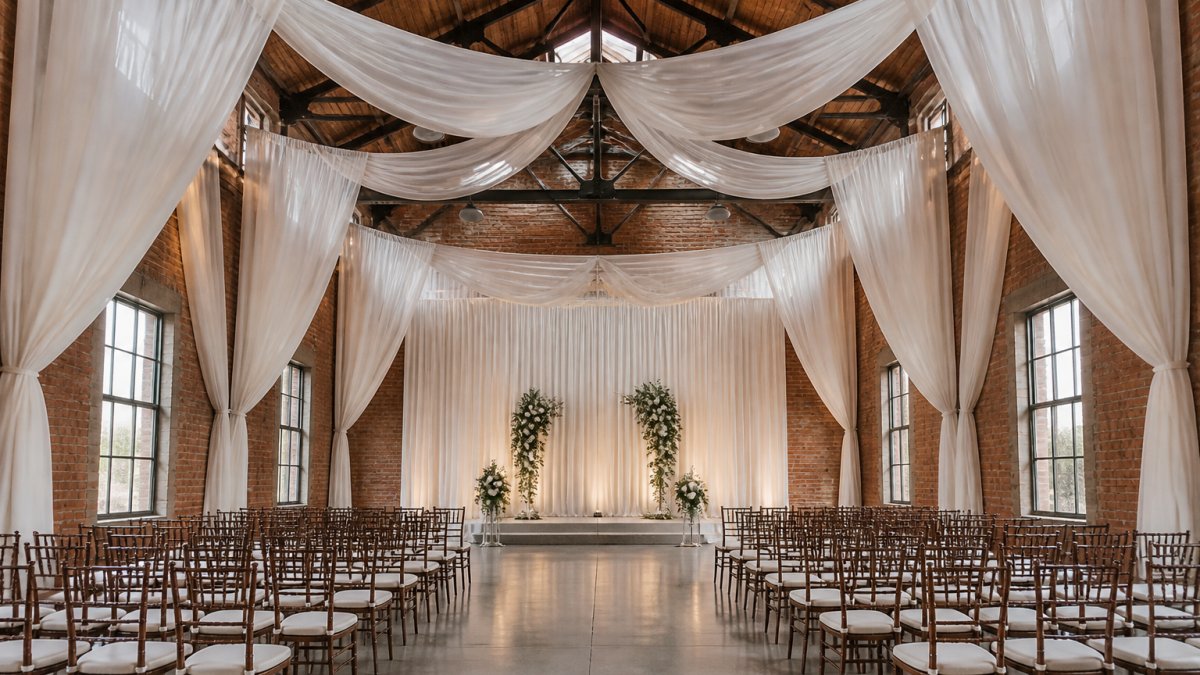
Voile backdrops create a soft focal point for ceremonies and receptions, letting ambient light and background elements show through for dimension.
For ceremony backdrops, voile works beautifully as a solo element or layered with other fabrics:
- Single-layer voile creates a subtle, romantic frame for the altar
- Layered voile in complementary colors adds depth and visual interest
- Voile with lighting behind it transforms the backdrop into a glowing focal point
Its translucency lets you position voile close to your ceremony space without blocking sightlines.
For receptions, voile backdrops work behind head tables, cake displays, or photo areas, catching uplighting or spotlights.
Draping voile from the ceiling creates a "floating" backdrop effect that works especially well in high-ceilinged venues, making the space feel larger.
Creating Soft Drapes, Curtains, and Room Dividers
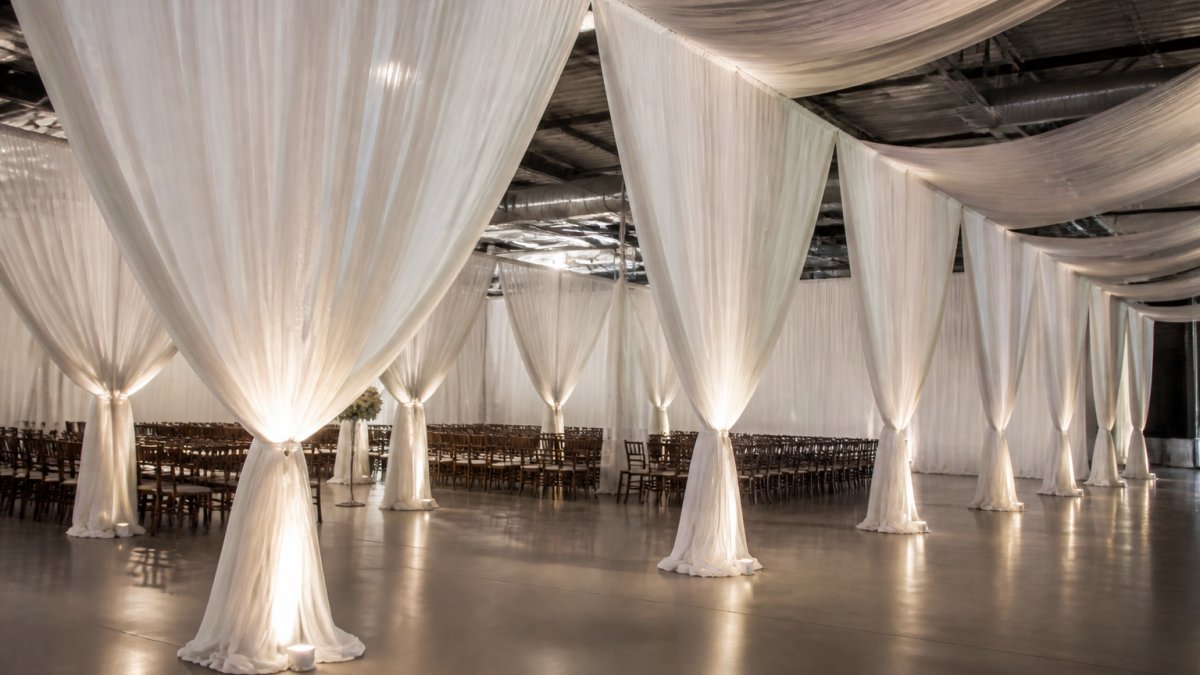
Voile drapes divide large spaces into intimate areas without blocking light or sightlines, keeping the space connected while creating distinct zones.
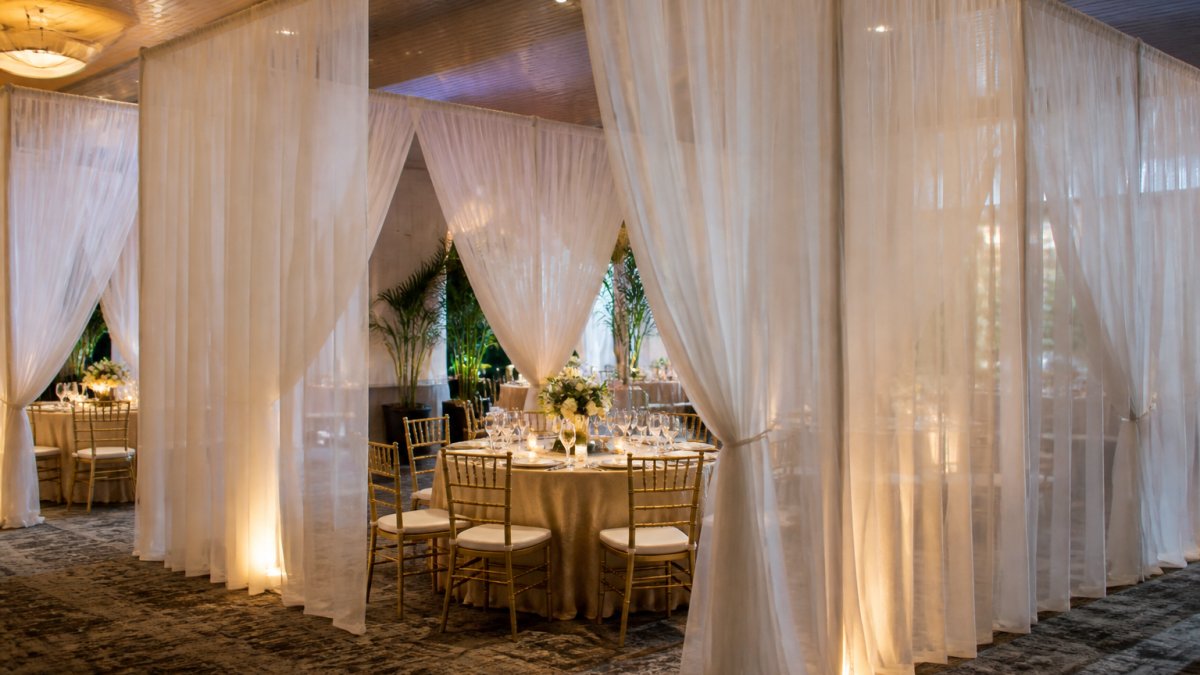
Use voile drapes to:
- Separate cocktail areas from dining spaces while maintaining visual openness
- Create a bridal suite or VIP lounge with privacy that doesn't feel enclosed
- Frame entryways and transitions between different event areas
Voile curtains mask storage areas, equipment, or unsightly venue features while the translucent quality keeps the space behind somewhat visible.
For ceiling treatments, voile creates a canopy effect that makes spaces feel more intimate in warehouses, ballrooms, and outdoor tents.
Voile's lightweight nature means fewer support points than heavier fabrics, reducing installation complexity and cost.
Voile vs Chiffon Fabric: Choosing the Right Material
Both voile and chiffon are lightweight, sheer event fabrics. Understanding the differences helps you choose the right one.
Voile fabric has a crisp, fine weave with a slightly structured feel.
Chiffon fabric is softer and more fluid, creating delicate, romantic drapes with less structure, but it wrinkles more easily and requires careful handling.
Key differences to consider:
| Characteristic | Voile | Chiffon |
|---|---|---|
| Weave | Fine, crisp | Soft, fluid |
| Wrinkle resistance | Higher | Lower |
| Drape appearance | Defined folds | Flowing, romantic |
| Opacity | Semi-sheer | Sheer |
| Durability | More durable | Delicate |
| Cost | ||
| Best for | Clean looks, room dividers | Romantic, flowing effects |
Choose voile when you want:
- A professional, polished appearance
- Fabric that maintains its shape throughout the event
- Easy setup and breakdown
Choose chiffon when you want:
- Maximum softness and romance
- Flowing, ethereal drapes
- A luxury feel
For most corporate events and large weddings, voile fabric events benefit from its practical advantages: it photographs well and looks sophisticated with minimal maintenance.
How to Hang Voile Drapes for Professional Results
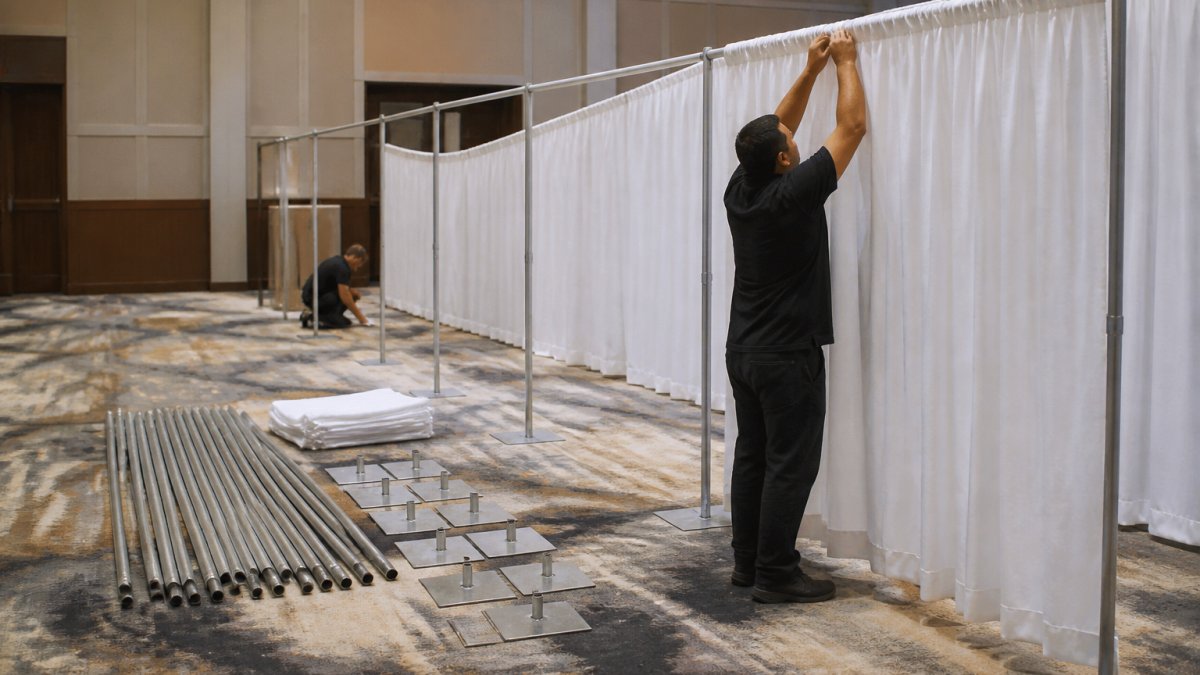
Proper installation keeps voile drapes polished and secure.
Basic installation approach:
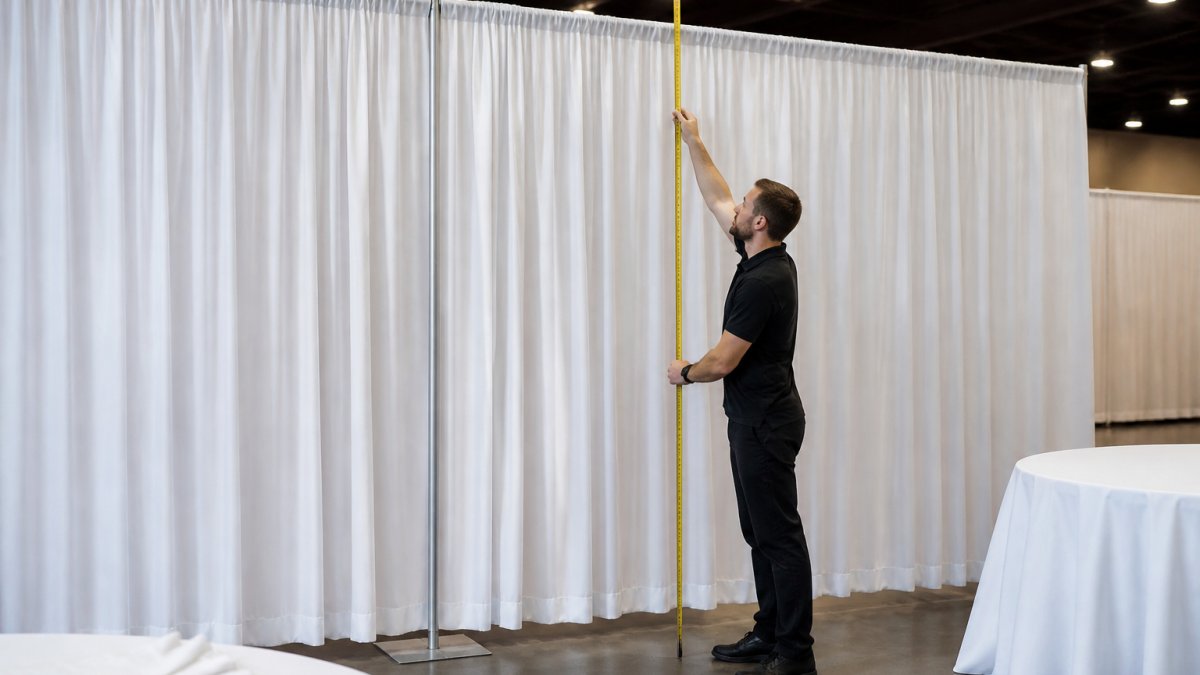
- Measure your space accurately, accounting for height and width of the area you're covering
- Plan your anchor points where fabric will attach to walls, ceilings, or pipe and drape systems
- Use appropriate hardware like clips, ties, or hooks designed for lightweight fabrics
- Hang fabric loosely to create soft, natural folds rather than pulling it tight
- Test the setup before the event to ensure it looks balanced and secure
- Adjust as needed for symmetry and professional appearance
For ceiling drapes, work from the center outward, starting at the highest point and working down the sides for balanced folds.
When draping from walls, secure the top first, then let the fabric fall naturally.
For large installations, professional setup ensures safety and appearance. Event Drape Rental provides both DIY options and professional installation.
Common installation mistakes:
- Pulling fabric too tight, removing the soft drape quality
- Using inappropriate hardware that damages delicate fabric
- Failing to account for fabric weight and sag over time
Voile Fabric Opacity and Light: Understanding Transparency
Voile's transparency is why it works at events, but "semi-sheer" isn't a fixed number: the same panel can read nearly opaque in a dim ballroom and almost invisible against a bright window.
How light source changes the look
Voile diffuses light rather than blocking it, so the direction and color temperature of your light source matter as much as the fabric.
- Backlighting: The classic voile effect. Place a fixture behind the fabric and the panel glows, with the weave becoming a soft texture rather than a visible grid. Warm white (around 2700-3000K) reads romantic; cooler temperatures (4000K and up) read modern and clean.
- Sidelighting: Grazing light from the side emphasizes folds and depth. This is the technique that makes a plain white backdrop look dimensional in photographs.
- Uplighting: Fixtures on the floor aimed up create a gradient, bright at the base, fading toward the top. Effective for ceremony aisles and stage edges.
Indoor vs. outdoor performance
Voile behaves differently indoors and outdoors.
- Indoor: Stable humidity and no wind mean the fabric hangs the way you set it. Air conditioning can dry the fabric and slightly stiffen cotton voile; polyester is largely unaffected.
- Outdoor: Wind is the dominant variable. Voile catches air easily, so panels need more anchor points than an indoor installation of the same size, typically every 12-18 inches along the top edge instead of every 18-24. Humidity can make cotton voile feel heavier and droop; polyester stays lighter. Direct sun will make white and pale voile glow brightly and can wash out darker colors over a long day.
How color and layering change opacity
Opacity isn't just about the fabric, it's about the stack.
- Single layer, light color: Most transparent. Great for backlit backdrops where you want the light to dominate.
- Single layer, dark color: More coverage, still semi-sheer. Useful when you want privacy without a solid wall.
- Two layers: Noticeably more private. A common pattern is a white layer in front of a colored layer to create a soft tint without losing glow.
A practical trick: hang a sample panel in the actual venue at the actual event time and photograph it. Daylight at 4 p.m. and candlelight at 8 p.m. will not read the same.
Voile's transparency is a variable, not a fixed property. Test it in the venue, at the event hour, with the actual lighting you plan to use.
Cleaning, storage, and reuse
- Wrinkle removal: Polyester voile usually hangs out most wrinkles within a day on a hanger. Cotton voile often needs steaming. Avoid high heat, most voile is heat-sensitive and can scorch or shrink.
- Laundering: Follow the care label. Polyester is typically machine-washable on gentle and can be tumble-dried low or hung to dry. Cotton voile is usually hand-wash or gentle cycle, cold, and air-dry. Never bleach unless the label says it's safe.
- Flame-retardant treatments: If your voile was treated for flame retardancy, check whether the treatment survives washing. Many do not, and re-treatment may be required before the next event.
Matching voile to the event conditions
A short decision guide:
- Indoor, controlled lighting, formal: Single or double layer, white or ivory, backlit. Easiest to plan and most forgiving.
- Indoor, mixed daylight and evening: Test both lighting conditions; consider layering so the fabric reads well as light shifts.
- Outdoor, calm weather: Polyester voile, extra anchor points, avoid dark colors that absorb heat.
Practical Planning: Quantity, Budget, and Venue Considerations
"Measure your space" is useless the moment you're standing in a 40-foot ballroom figuring out how many panels to order. Here's the actual math, hardware, and venue rules that determine whether your installation looks polished or improvised.
Measuring a venue and estimating yardage
Map every surface you plan to cover, recording three numbers per run: finished height, finished width, and fullness ratio.
- Finished height: Measure floor to your highest anchor point, then add 6-12 inches for a bottom pool or hem allowance. A 12-foot ceiling with a 6-inch pool means you cut panels at roughly 12.5 feet.
- Finished width: Measure the span you're covering, not the fabric width. A 20-foot backdrop is 20 feet of finished width.
- Fullness ratio: This is where most DIY estimates fail. Flat-hung voile uses a 1:1 ratio. Soft, gathered folds typically need 1.5:1 to 2:1. Deep, dramatic swags can push 2.5:1 or higher.
A simple working formula:
Total fabric width = finished width × fullness ratio
For a 20-foot backdrop at 2:1 fullness, you need 40 feet of fabric width.
Total yardage = (number of panels) × (panel height in feet ÷ 3)
Five panels at 12.5 feet each = 62.5 feet of fabric = roughly 21 yards.
Choosing panel widths and seam placement
Voile comes in a few common widths, most often 54-inch and 118-inch (sometimes labeled 110- or 120-inch). Wider bolts mean fewer vertical seams and a cleaner look, which matters for backdrops photographed straight-on.
- 54-inch voile: Better for table runners, chair swags, and narrow accent drapes. You'll need more panels to cover a wide span, and seams will be visible unless you hide them behind florals or lighting.
- 118-inch voile: The standard choice for ceiling-to-floor backdrops and room dividers. One panel covers nearly 10 feet of width, so a 20-foot backdrop needs only two to three panels before fullness is applied.
Place seams where they'll be least visible: behind a head table, inside a fold, or aligned with a structural column. Avoid centering a seam on a ceremony arch or photo backdrop.
Attachment methods for common event structures
Voile is light enough that you rarely need heavy rigging, but the attachment point must match the surface.
- Pipe and drape kits: Use the slip-on rod pockets or drape pins that come with the kit. Voile slides easily and won't strain the crossbar.
- Ceiling grids and truss: Attach with ball bungees, zip ties, or S-hooks rated for the load. Space attachment points every 18-24 inches along the top edge to keep folds even.
- Walls and columns: Command hooks, adhesive clips, or tension rods work for short runs. For longer spans, use a top rail or wire suspended between two anchors.
Venue rules, flame retardancy, and load limits
Before finalizing any design, ask the venue three questions:
- Does the fabric need to be flame retardant? Many public assembly venues, including hotels, convention centers, and theaters, require drapery to meet a recognized flame-retardancy standard. In the U.S., that's typically NFPA 701 for textiles used in public occupancies, and some jurisdictions also reference California Title 19. Ask whether the venue needs a certificate of flame retardancy, and confirm your rental or purchased voile carries one.
- What are the ceiling-load limits? Even lightweight voile adds up. A 20-foot by 12-foot backdrop at 2:1 fullness can weigh 15-25 pounds depending on fabric weight and hardware. That's usually fine on a truss or pipe-and-drape system, but many venues prohibit attaching anything to finished ceilings, fire sprinkler heads, or HVAC diffusers.
- What's the clearance from lights and heat sources? Keep voile at least 12-18 inches from hot fixtures, and never drape it directly over or against a par can, moving head, or open flame. Voile is combustible, and proximity to heat is the single most common cause of event-fabric incidents.
Flame-retardant treatments can wash out. If you're reusing voile across multiple events, ask your supplier whether the treatment is durable or whether the fabric needs re-treatment after cleaning. Venues that require certification will ask for documentation each time.
Budget factors that actually move the number
Pricing depends on quantity, dates, and delivery. The variables that most affect your total:
-
Fiber: Polyester voile is generally more wrinkle-resistant than cotton voile. Cotton has a softer hand but wrinkles more and can shrink.
-
Width: 118-inch bolts often mean you need fewer yards.
-
Installation labor: Professional installation reduces the risk of damage to the fabric, the venue, or the schedule. DIY is realistic for pipe-and-drape backdrops and table decor; ceiling work in a tall ballroom is not.
A quick planning checklist
- Measure every run and write down height, width, and fullness ratio.
- Convert to panels and yardage using the formulas above, then add 10 percent.
- Confirm fabric width and whether seams will be visible.
Get these numbers right and installation becomes straightforward; skip them and you'll be re-ordering fabric the week of the event.
Frequently Asked Questions
What is voile fabric made of?
Voile is a lightweight, fine-weave fabric typically made from cotton, polyester, or cotton-polyester blends. The tight, even weave creates its characteristic sheer, semi-transparent appearance while maintaining strength and durability. Cotton voile offers a natural, breathable feel ideal for events requiring soft aesthetics, while polyester voile provides wrinkle resistance and easier care, both popular choices for voile fabric used in event decor.
Is voile a good fabric for event backdrops?
Yes, voile is an excellent choice for event backdrops. Its translucent quality allows light to pass through, creating soft, romantic lighting effects that enhance photography. The fabric drapes beautifully with soft folds, adds dimension to plain walls, and works for weddings, corporate events, and special occasions. Voile for event backdrops is versatile and can be installed with pipe and drape systems or DIY methods.
How do you keep voile drapes from wrinkling?
To minimize creasing: store drapes on wide hangers or rolled loosely rather than folded tightly, allow them to hang for 24 hours before your event to let gravity release minor wrinkles, and avoid compressing them during transport. If wrinkles appear, a light steaming or low-heat iron on the back side works well.
Can voile fabric be used for outdoor events?
Voile works well for outdoor events in calm conditions, creating dreamy, romantic atmospheres. However, wind can be challenging, flowing voile requires secure anchoring to pipe and drape systems or weighted bases. For outdoor use, consider polyester voile for better durability and weather resistance. Avoid outdoor voile in high winds or heavy rain, and plan for adequate lighting since the sheer fabric's transparency reduces its impact in bright daylight compared to indoor venues.