 listicle
Are Barn Wedding Drapes Worth the Cost?
Last Updated: October 24, 2026
Quick Summary
Barn wedding draping softens a raw agricultural space into a finished room by framing the barn's exposed structure rather than covering it. It pays off most when it replaces a rental wall, rescues one difficult wall, or doubles as lighting infrastructure. Fabric goes up first, then lighting, greenery, and tables are built on top.
- Drape only the one or two walls your guests actually face, not every wall.
- Keep the hem 6 to 12 inches off the floor to avoid wicking moisture and dust.
- Ask the venue in writing what you may hang from before signing a drape contract.
- Keep fabric at least 12 inches from any heat-producing light fixture.
- Send five items, including measured dimensions and clear height, to get a usable quote.
Table of Contents
- Why Barn Wedding Draping Changes the Room
- Barn Wedding Draping Ideas That Fix Real Venue Problems
- How to Decorate a Barn for a Wedding Reception With Draping as the Base
- Wedding Reception Curtain Ideas for Dividing and Defining Space
- Wedding Draping Fabric Ideas for Barn Conditions
- Safety, Installation, and Venue Rules to Settle Before You Book
- Budget Trade-Offs: Where Draping Pays Off and Where It Doesn't
- Requesting a Draping Quote for Your Barn Wedding
- Frequently Asked Questions
Why Barn Wedding Draping Changes the Room
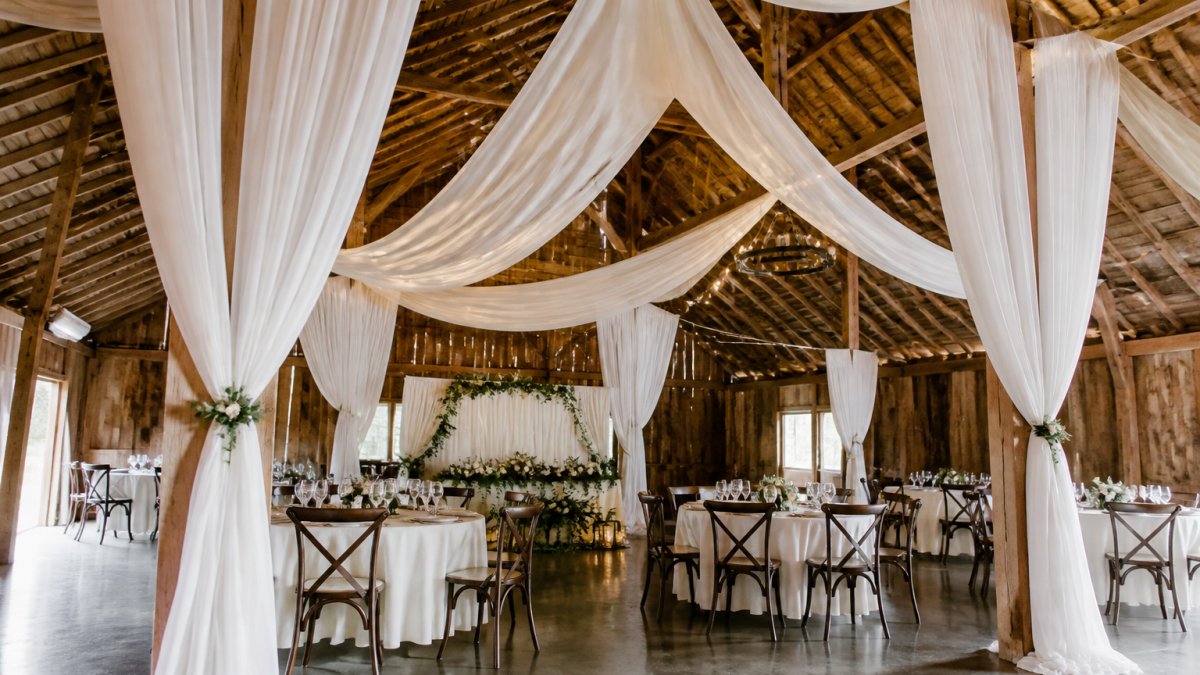
Barn wedding draping is the practice of hanging fabric across walls, ceilings, and structural beams to soften a raw agricultural space into a finished ceremony or reception room.
You do not want to cover up the barn. You want to frame it.
Most barn draping advice online is inspiration-first and logistics-last. That ordering is backwards: draping is a structural decision before it is a decorative one.
Barn Wedding Draping Ideas That Fix Real Venue Problems
Barn wedding draping ideas work best when they start from a specific flaw rather than a mood board. Every barn has two or three visual problems worth solving, and draping solves them well because it is temporary, reversible, and adjustable on site.
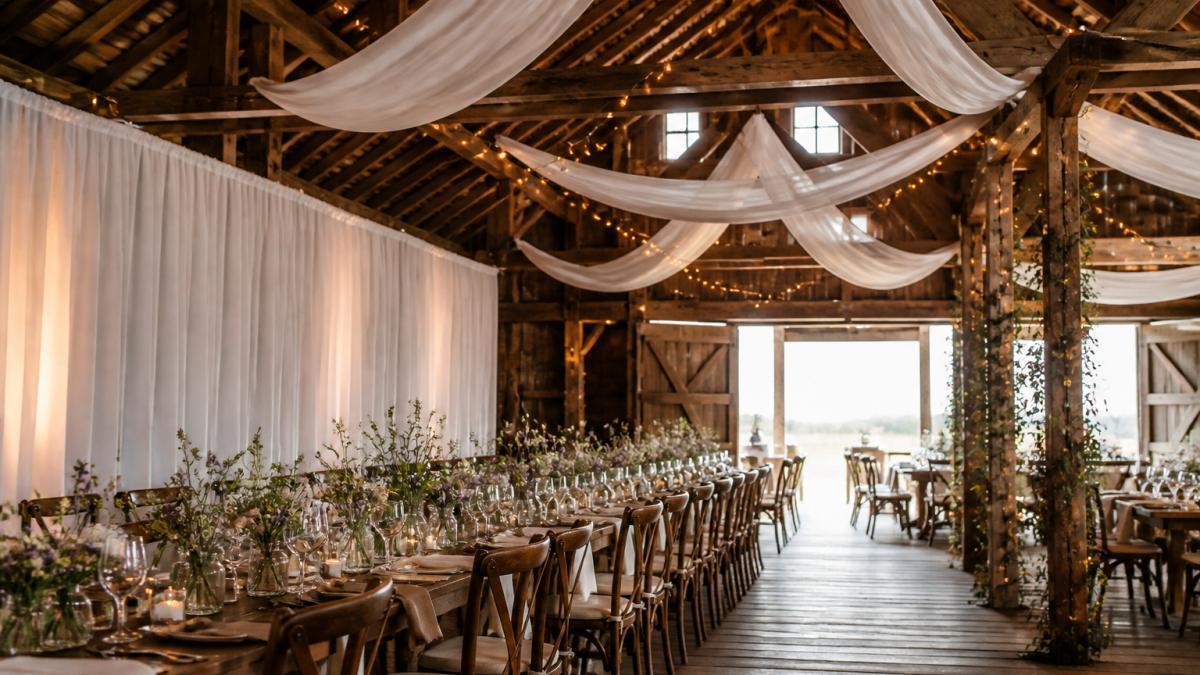
The two most common problems are plain or damaged walls and ceilings too tall to feel intimate. Both are fixable without draping the entire building.
Covering Plain Walls and Unattractive Corners
Plain walls and unattractive corners are the fastest win in any barn. A single draped wall behind the head table or ceremony arch redirects attention from patchy paint, conduit, or a service door, and costs far less than wrapping the whole room.
Draping every wall can flatten the space and remove the texture people came for. For a deeper walkthrough, see our guide on how to hide venue walls with drapes.
Softening a Tall Ceiling Without Losing the Barn Character
A tall ceiling reads as cold when the fabric stops at the walls.
Keep at least one sightline to the original roof line. That single open section is what preserves the barn character while the draped sections do the softening. Our article on styling wedding draping for high ceilings covers the specific rigging approaches for tall spaces.
How to Decorate a Barn for a Wedding Reception With Draping as the Base
Decorating a barn for a wedding reception starts with draping as the base layer, then building lighting, greenery, and tables on top. Fabric goes up first because everything else is positioned relative to it.
Here is the sequence we recommend:
- Choose the focal wall. Pick the wall behind the head table, cake, or band. Drape that one first.
- Set the ceiling treatment. Decide whether you are swagging from the ridge, running fabric along the trusses, or leaving the ceiling open.
- Install lighting after fabric. String lights and uplights read completely differently against fabric than against raw wood. Hang them once the drapes are in place.
- Add greenery last. Greenery softens the transition where fabric meets beam and hides hardware.
- Test the color palette under the venue's actual lighting. Barns have warm, dim light. A fabric color that looks crisp in a showroom can turn muddy in a barn at dusk.
Wedding Reception Curtain Ideas for Dividing and Defining Space
Wedding reception curtain ideas matter most in open-plan barns, where one long room must hold dinner, dancing, and a bar without any feeling like an afterthought.
Three approaches work reliably:
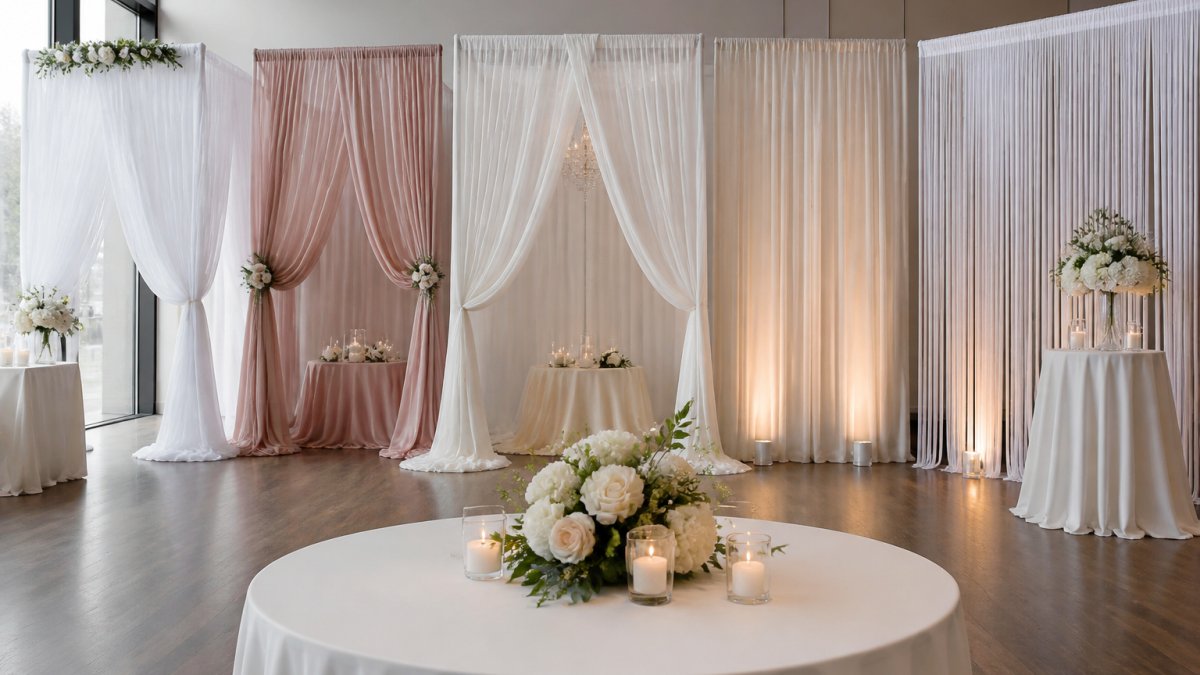
- Backdrop curtains behind the head table or band, floor to ceiling, to anchor the room's focal point.
- Partial dividers hung from a pipe and drape system to separate the bar from the dining floor while keeping sightlines open.
- Entry drapes at the barn doors, gathered to one side, which frame the reveal as guests walk in.
The advantage of a pipe and drape system over built-in rigging is that it is freestanding: you can define a space in the middle of a barn floor without drilling into anything, and move it after the ceremony.
Wedding Draping Fabric Ideas for Barn Conditions
Fabric choice in a barn is a practical decision before an aesthetic one. Barns are drafty, dusty, and often unheated, and fabric must survive transport, outdoor air, and hours of handling without looking tired by dinner.
Here is how the main fabric families actually behave in barn conditions, and what to specify when you request samples.
Sheers and Voile: Light, Air, and Structure
Sheer fabrics, voile, chiffon, and lightweight organza, are the default for ceiling treatments and backdrops because they let light through and keep the barn's structure visible.
The trade-off is that sheers show every wrinkle and shadow, and a white sheer near a gravel floor or open door picks up a gray cast by night's end.
Matte Fabrics: Wall Coverage That Photographs Clean
For wall draping, matte fabrics, polyester matte jersey, matte satin, and crepe, are the workhorses. They absorb light instead of reflecting it, so there is no glare in flash photography and no hot spots under uplighting, and they hide wall imperfections.
Matte fabrics are more wrinkle-resistant than sheers, but heavier fabric adds rigging weight.
Heavier Fabrics: Dividers, Doors, and Draft Resistance
Barns move air, and a divider that billows every time someone walks past looks unfinished. For dividers, door treatments, and any fabric that must hang straight, specify a heavier fabric, a lined polyester, a mid-weight velvet, or a structured dupioni.
The trade-off is weight and cost: heavier fabric costs more per panel, needs more support, and is harder to transport and store. It is worth it only where the fabric has a job to do.
What to Avoid in a Barn
High-sheen fabrics, shiny satin, metallic lamé, anything with visible luster, are wrong for most barns. They catch every uplight, reflect the ceiling, and show wrinkles and handling marks more than matte fabrics.
Also avoid unlined lightweight fabrics where the back will be visible: guests see the back of ceiling drapes from below and wall drapes from the side, and an unlined sheer shows every seam and rigging point.
Dust, Humidity, and Wrinkle Resistance
Three questions to ask your drape provider before you commit:
- Is the fabric pre-shrunk or stabilized? Humidity can cause natural fibers to relax or shrink, which changes the hang mid-event.
- How does it release wrinkles? Most polyester event fabrics release wrinkles when hung under slight tension; natural fibers often need steaming on site.
- What is the care and cleaning protocol? A fabric that cannot be spot-cleaned or machine-washed is a poor fit for a dusty venue.
If you are comparing sheers specifically, our roundup of the best sheer fabrics for wedding draping breaks down how each one behaves under event lighting.
Fabric choice in a barn is a practical decision first, so here is how the main fabric families behave in barn conditions.
| Fabric family | Best for | Key trade-off |
|---|---|---|
| Sheers and voile | Ceiling treatments and backdrops | Shows every wrinkle and shadow |
| Matte fabrics | Wall coverage that photographs clean | Heavier fabric adds rigging weight |
| Heavier fabrics | Dividers, doors, draft resistance | Costs more per panel, harder to transport |
| High-sheen fabrics | Deliberate glam contrast only | Catches every uplight, shows wrinkles |
| Unlined lightweight fabrics | Not recommended where back is visible | Shows every seam and rigging point |
Safety, Installation, and Venue Rules to Settle Before You Book
Safety and venue rules are the part of barn draping that gets skipped, and the part most likely to cost you. Barns are often working agricultural buildings with insurance conditions, load limits, and fire codes a standard banquet hall does not have. The questions below determine whether your design is buildable.
Attachment Points and Load Limits
Ask the venue in writing what you may hang from and what is off limits. Many barn owners prohibit attaching anything to structural trusses, and some prohibit attaching to any structural member.
A freestanding pipe and drape system avoids structural attachment entirely, which resolves most venue objections in one move. If the venue does allow attachment, ask for the specific approved points and the maximum load per point.
Flame Retardancy and Documentation
Ask your drape provider for documentation on flame-retardant treatment. Venues and fire marshals increasingly require it, and it is a standard question on venue contracts.
Two practical notes: flame retardancy can degrade with repeated cleaning, so ask whether the treatment is durable or whether the fabric needs re-treatment; and keep the documentation on site during the event, because a fire marshal can ask for it during a walkthrough.
Clear Height and Rigging Math
Confirm the actual clear height at the point of installation, not the building's peak. A 40-foot ridge does not mean 40 feet of usable rigging.
Measure at the specific point where the drape will hang, to the nearest inch, then subtract the drop of your hardware and any lighting hung below the fabric.
Electrical and Lighting Clearances
Keep fabric at least 12 inches from any heat-producing light fixture, and never drape fabric directly over or against a fixture.
Confirm the venue's electrical capacity and outlet locations. A barn with a single 20-amp circuit will not support a large lighting design, and extension cords across a walkway are both a trip hazard and a code issue.
Egress, Walkways, and Accessibility
Fabric must never obstruct an exit, fire extinguisher, or accessible route. Keep exits clear to their full required width, and do not run fabric across a doorway or in front of exit signage.
Keep at least 36 inches of clear width on accessible routes, and avoid fabric that drapes to the floor where it could catch a wheelchair or walker.
Setup and Strike Windows
Barns often have tight access hours. Confirm when your crew can get in and when everything must be out, whether the venue charges for early access or late strike, and whether there is a loading dock or only a gravel drive.
Budget Trade-Offs: Where Draping Pays Off and Where It Doesn't
Draping pays off where it replaces something more expensive, and does not pay off where it competes with the barn's own character.
Where it earns its cost:
- Replacing a rental wall or built structure. A draped backdrop costs less than building a set.
- Rescuing a difficult wall. Covering one bad wall changes the entire room for a fraction of a full-room treatment.
- Doubling as lighting infrastructure. Draped beams give string lights somewhere to live.
Where it does not:
- Wrapping a barn that already has beautiful, intact interior structure.
- Draping low-traffic areas no guest will photograph.
- Choosing fabric that needs replacing mid-event because it was wrong for the conditions.
Pricing depends on quantity, dates, delivery, and installation, so there is no honest single number to quote. To understand how draping is priced per square foot before deciding, see our guide on event draping cost per square foot.
Requesting a Draping Quote for Your Barn Wedding
A good quote request gets you a usable number instead of a range. The difference is in what you send.
Include these five things:
- Venue name and address, plus the venue contact who can confirm rigging rules.
- Measured dimensions for each area you want draped, width and clear height.
- Photos of the space, including the walls and ceiling you want to change.
- Your event date, load-in window, and strike deadline.
- Whether you want DIY or professional installation. These are different quotes.
Send those five items and you will get a specific answer rather than a follow-up question. We stock drapes from 12 to 30 feet in height, with more than 100 colors and 6 fabric materials, and offer both DIY and professional installation, so the quote is built around your actual venue.
The real challenge with barn draping is not choosing a look. It is matching the fabric, height, and installation method to a building never designed for events. Get those three aligned and the room does the rest.
Event Drape Rental supplies pipe and drape systems built for exactly this: drapes from 12 to 30 feet tall, more than 100 colors, 6 fabric materials, and your choice of DIY or professional installation. Get started with Event Drape Rental and request a quote for your barn wedding with your venue dimensions in hand.
Frequently Asked Questions
What are the benefits of wedding draping in a barn venue?
Draping covers plain or damaged walls, hides storage and structural clutter, and softens a hard ceiling so the room reads as finished rather than empty. It also gives you a visual focal point for the ceremony, defines separate areas for dinner and dancing, and lets you bring in a color palette that ties the whole event together. For tall barns, ceiling draping pulls the eye down to guest level, which makes a large space feel warmer.
What fabric works best for wedding draping in a barn?
Match the fabric to the barn, not just the color. Sheer fabrics like chiffon and voile move with air and suit open-sided barns, while heavier fabrics such as matte satin or poly-blend drapery hold a clean pleat and block light or sightlines. Ask whether the fabric is flame-retardant treated, since many venues require it and some states enforce it. Event Drape Rental stocks multiple fabric materials and over 100 colors, so you can compare sheers against opaque options before committing.
How much draping do you need for a barn wedding?
Measure the walls you actually want covered and the ceiling span you want softened, then add extra for gathering and tie-backs. A single backdrop behind the ceremony arch takes far less fabric than wrapping three walls of a reception hall. Height matters too: barns with 20 to 30 foot ceilings need drapes long enough to reach the beams without piecing. Bring your measurements and ceiling height to your quote request so the yardage is calculated correctly the first time.
Can wedding draping make a barn venue feel more elegant?
Yes, and the effect comes from contrast. Draping leaves the barn's beams and boards visible while adding soft flowing fabric, so you keep the rustic charm and gain a refined backdrop at the same time. Pair white or ivory draping with greenery, wildflowers, and twinkling lights and the room reads as intentional rather than unfinished. Deciding how much to cover is the real design choice: full ceiling draping feels formal, while partial draping keeps the raw barn character front and center.